

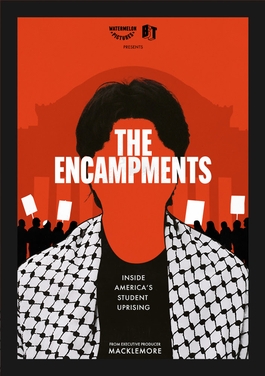
Image Credits: Watermelon Pictures via Wikipedia
Many West Chester University students remember where we were when Israel’s “war” on Gaza began almost two years ago on Oct. 7, 2023. Many of us also remember where we were when college campuses across the nation, including countless campuses here in Pennsylvania, erupted in anti-war and anti-apartheid protests during the Spring of 2024. Those who witnessed the months of turmoil will never forget the imagery: snipers atop school buildings, riot shields slamming into the bodies of elderly professors and teenaged students, bleeding young adults being dragged away in cuffs for holding signs and singing songs. Michael T. Workman and Kei Pritsker’s controversial documentary “The Encampments” (2025), which released in March of this year, captures all of this imagery and more. Because of its unflinching documentation of a watershed moment in public understanding of what is known as the Arab-Israeli conflict, “The Encampments” has been met with everything from police raids on campus screenings to smear campaigns from zionist influencers. With Hollywood turning more and more of an eye towards Israeli war crimes such as the murder of 6-year-old Hind Rajab, and Israel ramping up its efforts to fatally silence more local storytellers such as the team behind Oscar-winning documentary No Other Land (2024), an important question is being raised: if Israel’s military efforts are just, what about the camera makes them so afraid? Through documenting the war at home, “The Encampments” provides the answer: a camera pledges no allegiance.
“The Encampments” tells the story of the 2024 pro-Palestinian student protests through the lens of Columbia University, where the movement was sparked by the first official student encampment on Apr. 17. Using interviews with Columbia students such as Mahmoud Khalil (who just days before the film’s release was illegally detained by the Trump Administration for the activism featured here) as well as footage from within the protests themselves, “The Encampments” provides a look at what actually occurred within those encampments and what led to their brutal dismantling. Additionally, the orchestrated bipartisan effort to shut down the protests and demonize students is demonstrated through collected news coverage, institutional backlash, and politician response, and is paired with footage of the unfolding genocide in Occupied Palestine. Through the juxtaposition of universities in Gaza being bombed to ash with imagery of armed forces marching through American college campuses, the message is clear: imperialism is a threat to education everywhere.
The documentary has a very fine line to toe in its representation of the moment. Not only does it have to concern itself with bias, but it has to make sure the story of Americans is not eclipsing the plight of Palestinians at the hands of Israeli Occupation Forces. Workman and Pritsker accomplish this through the refreshing representation of both Arab and Jewish student voices, showing not only how the genocide an issue that transcends ethno-racial boundary, but how the issues of ethnic cleansing and occupation intertwine in the painful cultural histories of both identities. The Encampments also doesn’t ignore the history of Columbia’s violence towards student protestors, providing archival footage of the protests that took place on the campus during Vietnam, Civil Rights, and the Anti-Apartheid movement and citing the university’s horrific response to them. In the months since its release, Columbia has only further damaged its reputation through its capitulation to the Trump Administration, proving more and more that the encampments were a litmus test for the far-right institutional shift that was to come.
While Trump has only fueled the fires of genocide and modern McCarthyism (and the release date of “The Encampments” being pushed back due to the targeting of two of its subjects by the administration proves that), the film takes time to demonstrate how the occupation – and the aggressive attempts to silence its dissenters – is not a right-left issue, but rather an issue of power. Media figures, politicians, and university administrators of differing political affiliations, races, ages, genders and creeds all appear in the film parroting the same talking points against the student protests. Time is taken to remind us that moments of sadism like Khalil’s unconstitutional detainment are not solely the result of a Republican administration – but rather the picking up of where a Democratic administration left off.
Despite the film’s focus on Columbia as the epicenter of the student movement, it also dedicates itself to those on the ground in Palestine (such as award-winning journalist Bisan Owda) as well as to other schools across the nation that grew the movement outward from Columbia. The University of Pennsylvania makes a brief appearance, though Governor Josh Shapiro (D) – who allegedly used his influence to attempt to crack down on student activism at the school – is absent. Divestment from companies funding or supplying Israeli Occupation Forces – such as Ghost Robotics, a UPenn based company that manufactures “robot dogs” weaponized by the Israeli Occupation Forces – is stated as a primary demand of student protestors. No such divestment has been made since the film’s release. West Chester University, though absent from the encampment movement as a public university incapable of investment at the scope of universities such as Drexel or UPenn, has been embroiled in its own controversy on the issue of Palestinian activism. A posting policy limiting political expression on campus was added to the university’s guidelines following an alleged complaint over an anti-war message displayed in an office window.
“The Encampments” is terrifying both in hindsight and with each passing day, as we watch the fascism it depicts escalate even further under an unrestrained far-right government. The film’s release was delayed in March due to both the detainment of Khalil and the expulsion of Jewish Columbia student Grant Miner, another subject featured in the film, and in the following months the suppression of students who bravely fought against the institution in 2024 has only grown. All of this unfolding at the same time as Hollywood giants like Brad Pitt and Joaquin Phoenix turn their eyes towards Gaza only proves the message of “The Encampments” more. This was not the first time in history students protested against fascism, and it will not be the last. Like during Vietnam, students who dare to criticize America’s role in the mass-scale death and destruction unfolding in Palestine are met with state sanctioned violence. However late it is, the tide of mainstream narrative is already turning, and as Egyptian author Omar El Akkad put it “one day, everyone will have always been against this.” Perhaps, in 20 years, “The Encampments” will sit in a historical exhibition at Columbia as it sics police on the next generation of student protestors. Or perhaps we’ll have finally learned our lesson.
Elijah Fischer is a Fourth-Year English and MDC Major.