

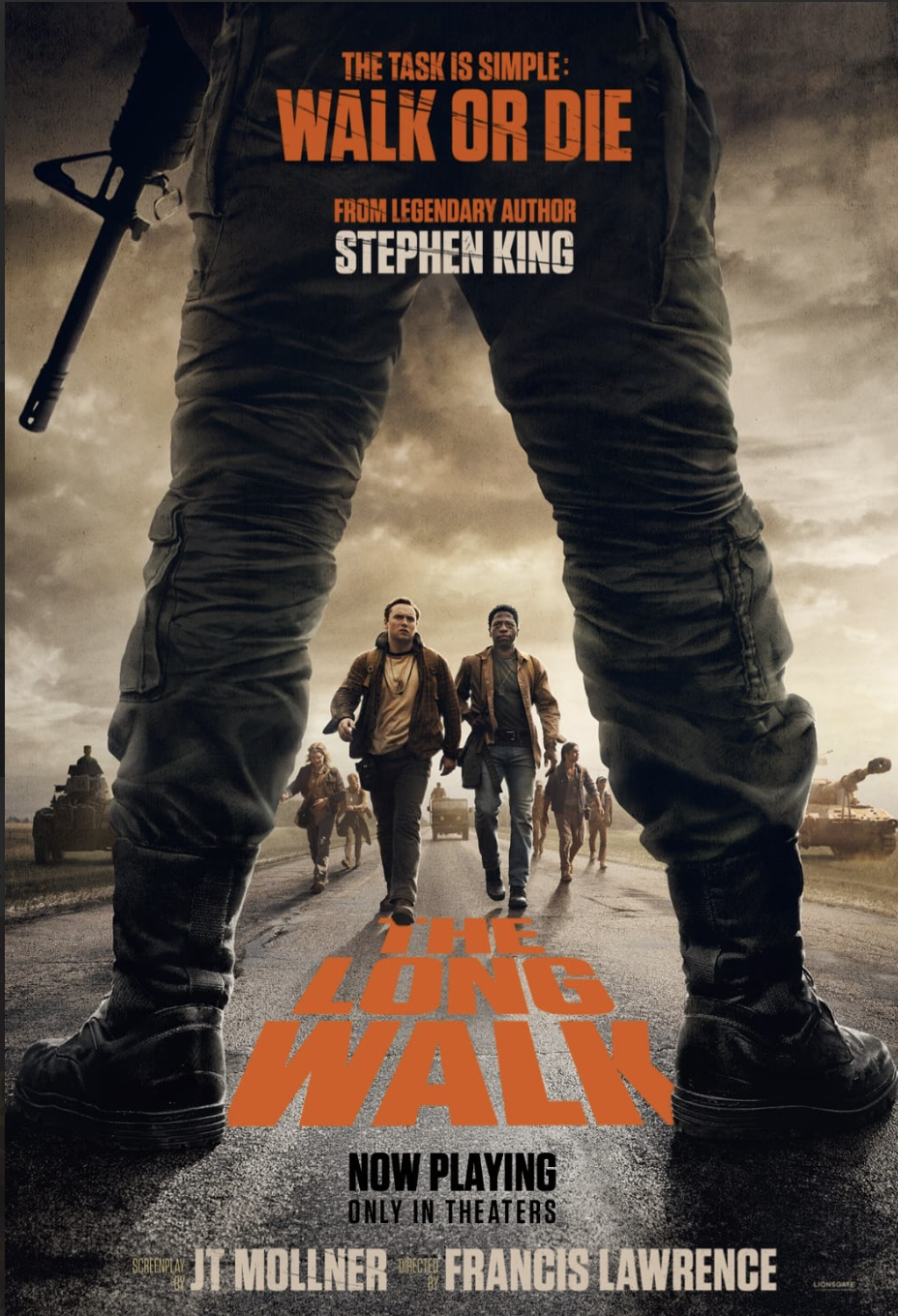
Image Credits: Lions Gate Entertainment Inc. via thelongwalk.movie
Dystopian fiction is one of those kinds of genres that is a hard sell to some audiences. After a hard day’s work, or during troubled times, some people generally want stories that are happy and rejuvenating like “Superman,” (2025) instead of sitting down to read “1984” (1949). One such dystopian story is also the latest Stephen King novel to get the Hollywood treatment: “The Long Walk” (2025) While there have been plenty of good Stephen King adaptations, there’s also been several bad ones, such as last year’s “Salem’s Lot” (2024). Surprisingly though, “The Long Walk” isn’t just a great Stephen King movie, it is also one of the best movies of the year.
Directed by Francis Lawrence, the movie opens up on an alternate 1970’s America, years after some massive war has left the nation in socioeconomic ruin. An authoritarian ruler known as “The Major” (Mark Hamill) now oversees a yearly event called “The Long Walk,” in which dozens of teenage boys compete to outlast one another in a grueling walkathon. Whomever wins, will receive a fortune and one wish, but whomever falls below 3.0 MPH for too long, will “get their ticket,” or more specifically…a bullet in the back. In this high stakes game of life-or-death, Raymond Garraty (Cooper Hoffman) befriends Peter McVries (David Johnson) as the two form a close brotherhood to brave the horrors of the deadly game they are participating in.
The movie starts out just like any Stephen King story: deliberately slow-paced, giving the audience time to meet new characters and understand the setting for the story. While this slow burn approach can be a poison chalice in some stories, it works in this instance as it gives the narrative a sense of forward momentum, both literally and metaphorically. However, even in a slow-paced story like this, the inciting incident makes the threat of violence brutally real when the first participant gets his ticket. From there on, the writing weaves between heartwarming, human moments of comradery to mortal terror as our ensemble cast of young men share their life stories, and mourn the sudden loss of their fallen friends, all while trying to be one step ahead of their ticket. Trying to thread that needle can be challenging for any author as the somber setting can make it difficult to watch, but screenwriter JT Mollner is able to take these characters from the pages of Stephen King’s work and compartmentalize them in a way that not only works for the big screen, but retains the depth of character that King painstakingly put into his original story.
Of course, making a good script doesn’t matter if the on-screen talent can’t make these characters come to life. Thankfully, the performances in “The Long Walk” are something special, comprising some of the best film acting of the entire year, and each of the ensemble cast members make these fictional people feel tangible and organic. David Johnson already proved his ability to act in 2024’s “Alien: Romulus,” (2024) but here, he demonstrates he can do so much more. His portrayal of McVries shows us a young man who was given a raw-deal by life so early on, but refuses to succumb to the darkness of this world and becomes a natural leader of this cadre of young men, displaying a level of charisma and confidence that becomes magnetic.
Meanwhile, Cooper Hoffman (the son of the late, great Philip Seymour Hoffman) turns in a more subdued performance as somebody with more secretive reasons for joining this death game, but is also able to play off of Johnson exceedingly well, going from friends to brothers before the story is over, and also portraying a youthful vulnerability to himself as these are still teenage characters.
Mark Hamill’s The Major, while not a constant on-screen presence compared to Johnson and Hoffman, is still noteworthy, as he goes from scene-chewing antagonist to a manifestation of the terror of authoritarianism run amok, almost never showing fear or vulnerability, and not easily goaded by petty jabs from the contestants. He is part tyrant, part abusive coach and ice-cold game show host all in one.
It is fitting that Francis Lawrence is the director of another dystopian movie, as he sets up this world using his own experience and skills as a filmmaker, but also with the right people such as Editor Mark Yoshikawa and Cinematographer Jo Willems.
In order to maintain this sense of building linear progression but also make the film engaging to watch, it was imperative that Lawrence and Yoshikawa keep the audience’s attention on such a simple, ordinary thing as people walking down a road. Because of this, it was critical that the film not shy away from keeping a constant focus on the ensemble cast, even when they meet their grizzly end, in order to help maintain a sense of the dwindling numbers of the cast and of constant momentum. According to an interview with “Definition Magazine,” Willems chose to use the ARRI ALEXA 35 with Super 35 format and atmospheric lenses, and it does a wonderful job of maintaining this feeling of raw realism and slightly-muted colors. While most audiences are frustrated with contemporary movies lacking in vivid colors, it fits with the grim subject matter of “The Long Walk,” but also isn’t too muted and gritty that it doesn’t capture gorgeous establishing and birds-eye-view shots seen on display, making audiences realize that there is still a sense of natural grace to this fictional world.
“The Long Walk” is not an easy film to watch. More than once, I had to look away because of how raw it can be, but that’s what makes this film so important. It works as a critique of the abuses of power that we see in our modern world, but also the feelings of innocence lost, and even the misery left in the wake of warfare. I can’t say if it is the best Stephen King movie, but I can confidently say it is one of the best of 2025!
Kelly Baker is an alumnus of West Chester University.