
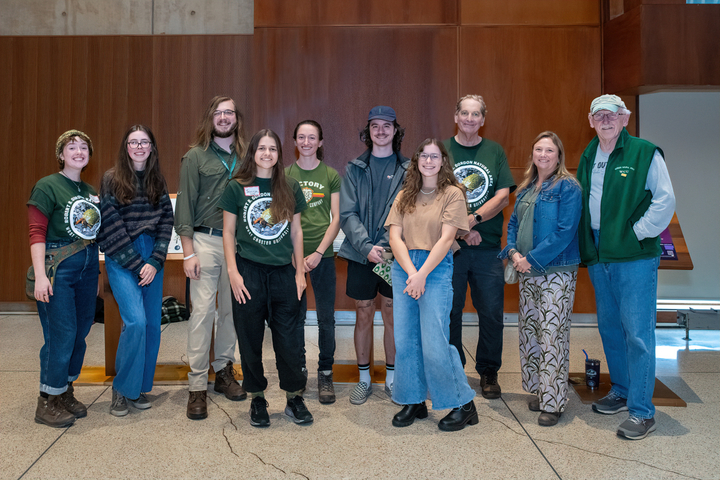
GNA Staff: Past and Present. Photo and caption by Erica Thompson, university photographer.
“These small preserved areas of our natural world are the symbols of our appreciation and concern for the heritage of Chester County, one of the truly beautiful areas in Eastern North America,” said Dr. William R. Overlease — a WCU professor from 1963-1986 — in his 1973 “Remarks for the Dedication of GNA for Environmental Studies.”
The weekend of Sept. 23, WCU celebrated the Gordon Natural Area’s (GNA) 50th anniversary, which highlighted the efforts made to protect the forest land. The natural area was dedicated in 1971 to a science faculty member at WCU, Professor Robert Gordon, and was established as protected land.
The GNA is approximately 126 acres worth of land, located on West Chester University’s south campus. This area serves as a refuge for native plants and local wildlife, as well as an area for people to enjoy nature.
In 1970, before the land was established as protected land, it was subject to proposed development of student housing by university administration.
In an article written in Quad Angles in 1971, Terry Cohen expressed concerns about GNA’s land. “The 200 acres, known as a ‘climax forest,’ is one of the only plots of land of its type in Chester County, supporting an eco-system containing a wide variety of plants and animals,” Cohen wrote.
This build was halted by two undergraduate students, David Fluri and Brad Gottfried. A movement was started by Fluri and Gottfried for the University to recognize how valuable the GNA land was for scientific studies.
Cohen mentions Fluri in his article, stating, “Fluri said that the swampland could not compare with what they have now; there wouldn’t be as many types of plants or animals to study.”
Fluri proposed an alternate plan of developing housing on the other side of New Street, using the cornfield that was dedicated to athletic fields. He reassured Hannum that this would be a better plan as the cornfield is much flatter than the forest land, making it less expensive to build on.
Fluri proposed an alternate plan of continuing the development of housing to the other side of New Street, using the cornfield that was dedicated to athletic fields. He reassured Hannum that this would be a better plan as the cornfield is much flatter than the forest land, making it less expensive to build on.
In his 1973 remarks, Overlease further asserted the importance of protecting the forest land. “It is also significant that our practical needs for an outdoor classroom and study area can be combined with an aesthetic and physiological need for space in a natural world.”
The efforts of students and professors succeeded as the GNA was established as a Wild Plant Sanctuary in 1973 by the Pennsylvania Department of Conservation and Natural Resources.
The GNA continues to serve as a site for students and WCU faculty to use for research. WCU’s own Dr. Jessica L. Schedlbauer, Professor of Biology, is currently conducting research with her students. The study includes collecting a census of carbon as well as trees and invasive species every five years to inspect how the forest alters over time.
In an interview with Dr. Schedlbauer, she discussed her research with students and how they explored the change of carbon over time, the composition of the trees, and how invasive species, such as lantern flies and emerald ash borers affect wildlife. She describes the GNA’s land to be a place where “students can learn how to do science and be inspired.”
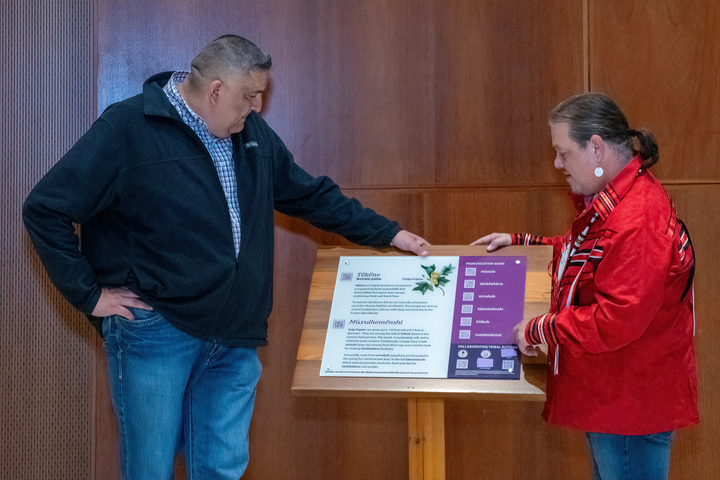
The event took place in the Sykes Student Union due to the weather. Many participated in games that provided information on nature. There was also a scheduled tour led by the Delaware Tribe of Indians. During my conversation with Dr. Schedlbaur, she discussed an ongoing project that was unveiled during the GNA’s 50th Anniversary celebration.
For the project, Anthropology professor Heather Wholey has worked with students to develop signage that highlights the cultural uses and understanding of the forest. Its display will provide information on how the land connects with the Lenape Tribe for all visitors to read and indulge in. This work was done in collaboration with the Delaware Tribe of Indians.
In an interview with GNA Student Intern, Mary Teresa O’Hara, she discussed the importance of the signage as a tribute to native tribes that had land taken from them. The signage explains the species of plants in GNA in the Lenape language.
O’Hara emphasized this tribute, as its goal is to “show we respect and look up to these native people.”
This tribute to the Lenape tribe will be built along Stadium Road, which will lead through different portions of the forest, leading to a meadow area.
Brianna Chau is a third-year student Political Science major with a minor in Philosophy. BC976136@wcupa.edu