

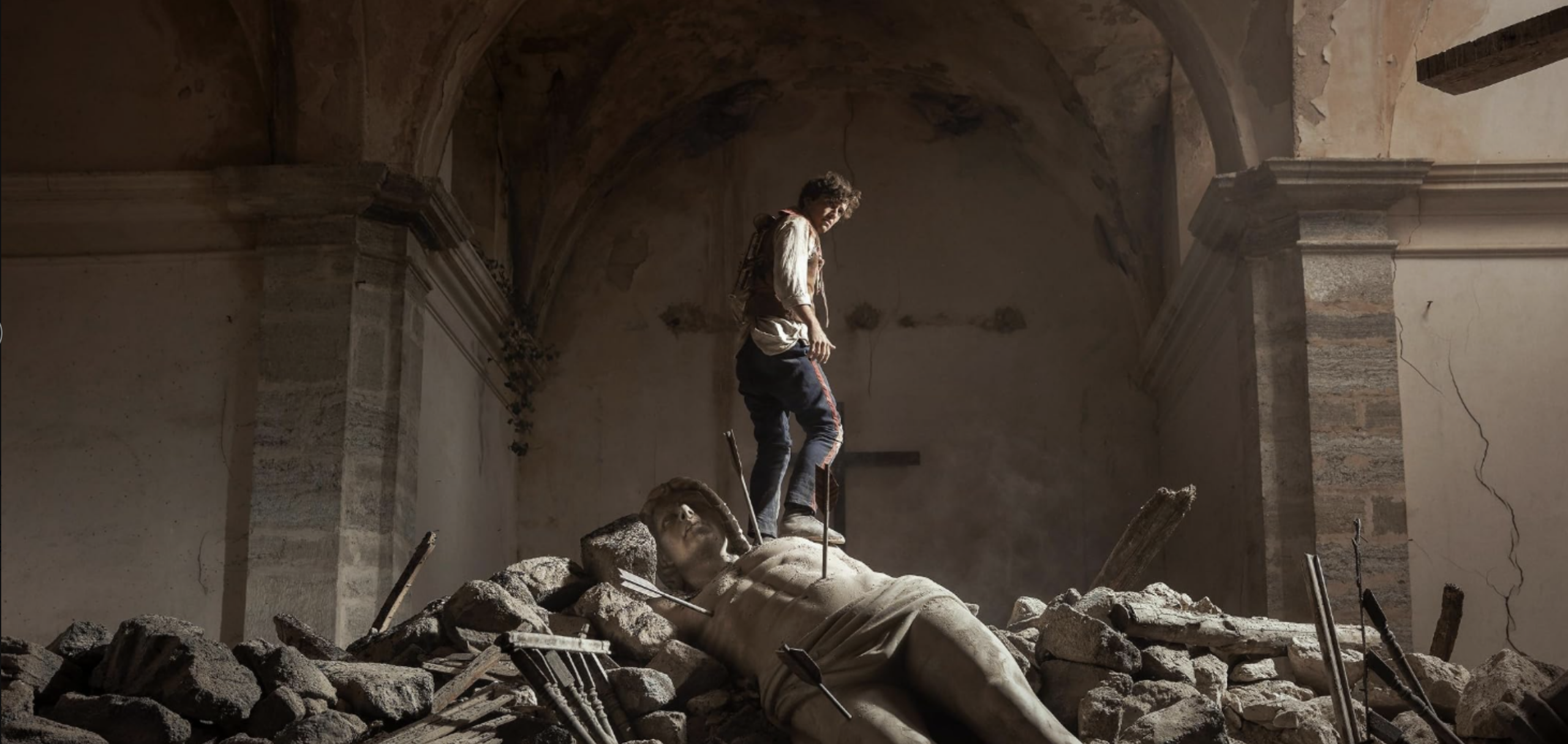
Image Credit: Photo by Carla Oset/Netflix – © 2026 Netflix, Inc. via IMDb
Like a penis, the impact of a great cinematic epic does not hinge on its size, but on how its girth is utilized. “La Bola Negra” (2026), a maximalist drama from director duo Los Javis, does not skimp on size. Three sweeping storylines that span a century of both real and imagined queer Spanish history all converge in the buzzy new film, managing to rekindle the magic of midcentury cinematic masters like David Lean despite a comparatively miniscule budget. However, with all its scope and magnitude, the film finds its Achilles heel in a surprisingly simple place: its heart. The film had its Pennsylvanian premiere as part of the 35th annual Philadelphia Film Festival, where it found a fitting home on the largest screen in the city of brotherly love. But in spite of its colossal presentation, the Academy Award-contending feature couldn’t help but stumble under its own weight when its passion and verve had to lean on the intimate rather than the spectacular, which leaves audiences with a lasting question: Even when it comes to epics, does size matter?
“La Bola Negra” follows three queer men throughout separate periods in Spain’s history. Carlos (Milo Quifes) is a closeted young aristocrat in 1932, desperate to join an elite social club despite how his suspected homosexuality has tarnished his reputation in the eyes of its powerful members. Sebastián (Guitarricadelafuente) is a soldier in the Francoist regime of 1937, tasked with guarding Rafael Rodríguez Rapún (Miguel Bernardeau), a Republican prisoner-of-war with ties to Spanish writer Federico Garcia Lorca. Alberto Azcuna (Carlos González), a failed-playwright-turned-historian, is left the finished manuscript of Lorca’s long-lost novel by his estranged grandfather in 2017, and seeks to honor his grandfather’s last wishes by restoring it to the family of a lover lost to time.
Operatic is the only word that can do this film justice. From its use of montage, to its sense of blocking, to the range required of its performances, “La Bola Negra” is embroiled in theatricality. The dramatic heaviness works effectively when applied to the film’s central themes of queer erasure and the echoing ripples of homophobia throughout history, especially when wielded by Carlos González in the movie’s most understated yet powerful role. However, that sense of passion disappears when it comes to the love story between Sebastián and Rafael Rodríguez Rapún. Their opposite worlds and the sense of self-discovery Rapún gifts to Sebastián seem to be acting as stand-ins for chemistry between the two men, in spite of the talent behind them. What’s shared between these two star-crossed lovers is supposed to act as the bridge between the titular story-within-the-story and the modern portion, as Sebastián is Alberto’s grandfather and Rafael is Lorca’s lover, but the importance of the time shared by these two characters is not felt beyond how the plot depends on it. Guitarricadelafuente and Bernardeau are given far too little to work with, and the lack of character to grasp on to leaves them unfairly adrift whenever the story returns to them.
Where the film stumbles turns a small grievance into a black hole that threatens to undermine the film’s entire guiding theme of holding on to history. “Queer people have always existed” is a valid point to make, but it’s one that disappears into the wind without something to tie itself to. With the shadow of the legendary Lorca, the film has given itself that anchor, but with his work and life mired in the stories-within-stories, it is less the soul of the film than one of many moving parts. Lorca, a real queer author who died at the hands of Francoists during the Civil War the film fictionalizes, gets lost in the reeds of storytelling. It brings into question why the film views holding on to queer history as so important: Is the love story between Sebastián and Rapún important because it’s powerful, or just because it’s queer? Azcuna’s character does away with that question through the uphill battle he must fight against family members who would rather he forget the past than drudge up unhappy memories, but Azcuna is not posited by the narrative as its most important figure. Like Lorca, he merely orbits around Sebastián and Rapún’s limpness.
“La Bola Negra” does fully not collapse under its bulk, but the emphasis on its spectacle does undermine its effectiveness in telling queer stories that will endure. There are dozens of films that could be made from the many lives it invites us into, and all are just as worthy of our attention. Queer people deserve to have their stories told in boisterous, big, bombastic epics, as straight people have unquestioningly for centuries. Unfortunately, when an epic is straight it is merely an epic, whereas a queer epic must be queer before it can be an epic. As a result, much of the spectacle “La Bola Negra” embraces comes from the spectacle of queerness itself rather than the dramatic power of its stories. Its filmmaking is still magnificent, but after the argument that queer stories deserve to be passed down has been made, what is left for it to say? “La Bola Negra” releases in select theaters on Nov. 6, and will be available to stream on Netflix in the U.S. starting Dec. 4, 2026. All we can hope is that the prison of a smaller screen will unearth as many hidden truths for it as Sebastián and Rapún’s did for them.
Elijah Fischer is a senior majoring in English with minors in Journalism and Film Criticism. He can be contacted at Af997636@wcupa.edu