

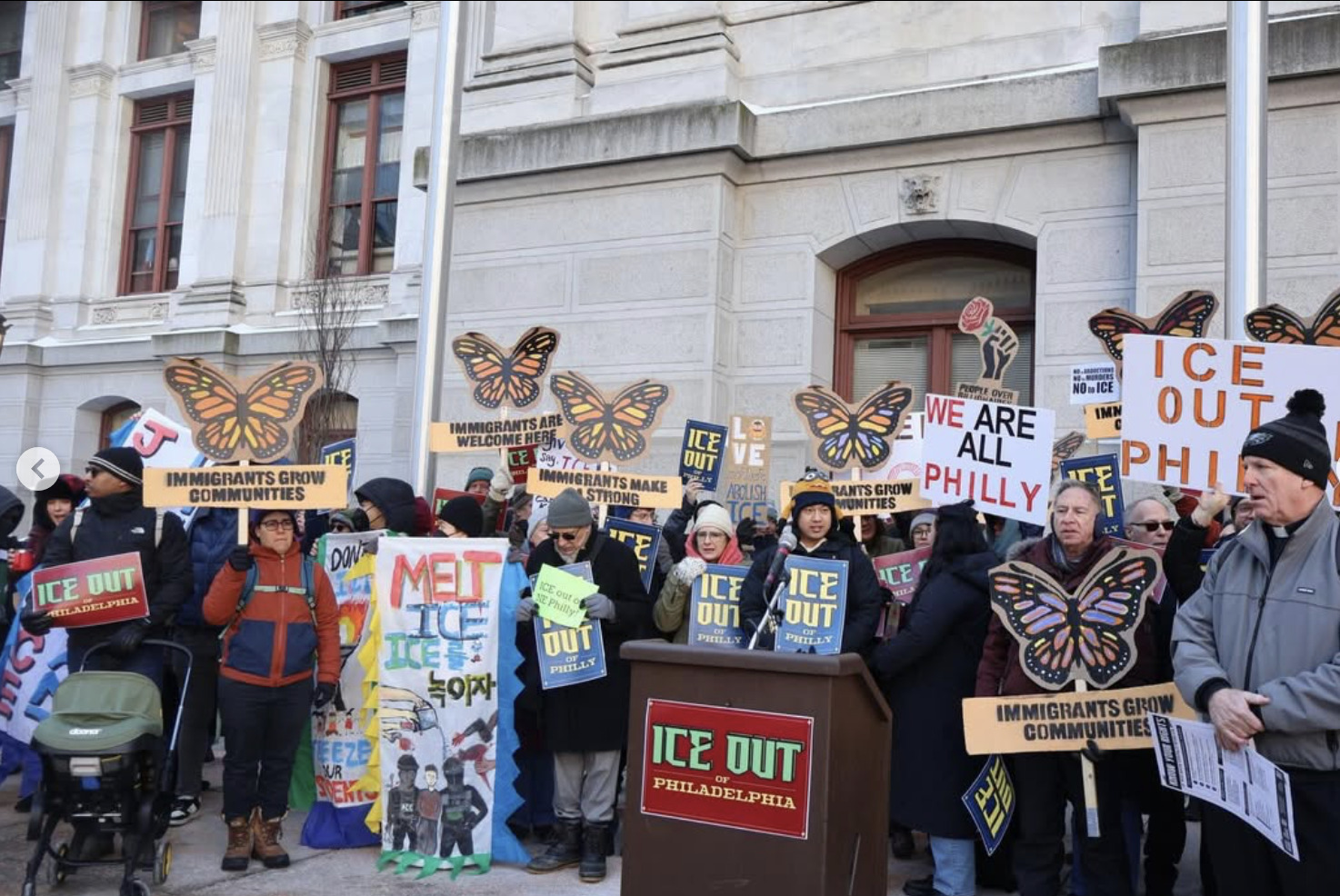
Pennsylvania has become a battleground in the Trump Administration’s war on immigrants. According to a report from the American Immigration Council the number of people detained by Immigration and Customs Enforcement (ICE) has increased by nearly 75% since President Donald Trump assumed office on Jan. 20, 2025.
In Pennsylvania alone, arrests of noncriminals by ICE made up over half of all ICE activity in the state, following orders by the Trump Administration last May to triple ICE’s daily arrest quota. According to state data published by the Migration Policy Institute, Asians are the largest immigrant group in Pennsylvania, making them the most at risk for targeting during ICE operations within the state. Despite this, the plight of Asian immigrants and Asian Americans under the ICE surge seems to largely be an afterthought, with basic necessities such as legal assistance, medical care and even simple communication being prevented at an institutional level. As seen from the suspicious deaths of Cambodian-American Paraday La and Chinese immigrant Chaofeng Ge while in ICE custody here in Pennsylvania, such negligence can be a matter of life and death.
The burden of outreach and education has fallen to community-led organizations such as Asian Americans United, a Philadelphia-based group that has been dedicated to fighting anti-Asian discrimination since 1985. “Now we’re having to do a ton of immigration work,” says Vivian Chang, Executive Director of AAU. “That includes case support. So folks reach out to us if their family member gets taken by ICE. We’re helping them find lawyers, we’re providing financial assistance, we’re helping them figure out ‘where did they go?’ because a lot of times ICE just moves them without telling families. We also do a lot of training and community support, helping people know their rights but also be prepared in […] tracking people who have been detained by ICE.”
“There’s not awareness around this,” Chang says, “but there’s a lot of folks where they’re taken at their ICE check-in. And for a long time you’d just do your ICE check-in instead of staying in the country, it was not supposed to be a dangerous place. All of the sudden, the Trump administration has just been detaining people [at their immigration check-ins]. Especially Asian Americans, that’s been really impacting them. We’ve also seen people taken from their cars on their way to work, and that means ICE is tracking them, waiting outside their houses. [How ICE is affecting Asian American communities] looks like a variety of things, but especially those two methods are something we’re trying to spread awareness about.”
In detainment, access is the name of the game, but for Asian Americans and immigrants in ICE custody even the simplest bits of accessibility can be an uphill battle.
“There’s a lot where people are just denied access to the outside world,” Chang said. “You have this thing called ‘commissary,’ where basically if you want to call your family you have to pay for your commissary. And we’ve had multiple instances where someone’s commissary has money in it but their calls are not going out, so people are just being forcibly isolated. It’s pretty bad.” Things only get worse when health comes into play. “There’s definitely some medical issues. They’re not getting medicine, there’s all these weird respiratory things, and if anything ICE gives people aspirin and that’s it.”
“We have worked with folks where their lawyer has been like ‘They just got detained, and they have diabetes medication and they need insulin. Sadly we know of one instance where a family was worried about bringing it up because they didn’t want ICE to use the illness against the person. In some cases, if you have a lawyer advocating for you then yes, they’re able to bring in medicines, but without it has been hard. Sometimes ICE just doesn’t pick up the phone, that’s the hardest part.”
Beyond the struggle for survival, even simple communication in detainment is an uphill battle for detained Asian immigrants due to a lack of resources for language barriers. “One person we knew,” Chang tells us, “he got detained and his children reached out to us. And [this person] ended up helping two Cantonese speakers there. They had no idea how to get anything like commissary. It’s super lucky they were detained at the same time, but ICE was not helping with that [language barrier] at all, those people would have just been stuck with no way to contact their families. There’s a lot of complete, purposeful negligence.”
Until fall of 2025, a Spanish language course for ICE agents was a mandatory aspect of training, and while that mandate has since been removed the agency still offers Spanish Language Training for agents, but no such instruction exists for any Asian languages.
While Philadelphia gears up for rumored surges in ICE enforcement, suburban communities face just as much fear and uncertainty. Speaking with Vanna Jiang, current President of West Chester University’s Asian Student Association, it became clear that the issues of transparency and feeling of abandonment exist among West Chester’s Asian community as well. “I’m not seeing very much [response to ICE] from the university,” Jiang said. “I think they love to use people of color when it’s beneficial for them, but in terms of having those hard conversations they either go unspoken or get brushed under the rug.”
Jiang, who has a green card holder in her family, spoke of the mental toll around dealing with mundane immigration paperwork around the height of “Operation Metro Surge” in Minneapolis, the chaotic ICE deployment that saw the murders of Renee Good and Alex Pretti. “I was feeling the stress of it. The green card services do not make it easy on you. They don’t have resources for people that don’t generally speak English well, and [during the interview] I couldn’t be there to translate for them. I sent all these documents, helped them fill out all these forms, and we still have not gotten the renewed green card. We’re just sitting around, not knowing if it’s gonna come. It’s very radio silence on their end.”
In terms of West Chester’s community and the university’s lack of support for immigrant students during this time, silence was also the operative word. “I feel like they take a very neutral perspective,” Vanna said. “They could be more of a resource. Exposure can show that this is happening to our community, and I’d hope [the university] would be more present. I think just being transparent and recognizing that it’s happening within West Chester’s community would be a good first step instead of turning a blind eye.”
Outside of West Chester, Pennsylvania’s Asian immigrant communities are continuing to push for visibility in their struggles against ICE. Meanwhile, local governments across the state such as Montgomery County are working to introduce more and more legislation aimed at limiting ICE activity and enshrining the protection of their communities from the unregulated agency’s operations into local law. Though progress moves slowly, community outreach continues to be the front line in community protection, with neighbors working tirelessly to plug the gaps left by institutional failures.
Elijah Fischer is a fourth-year English major. AF997636@wcupa.edu.