

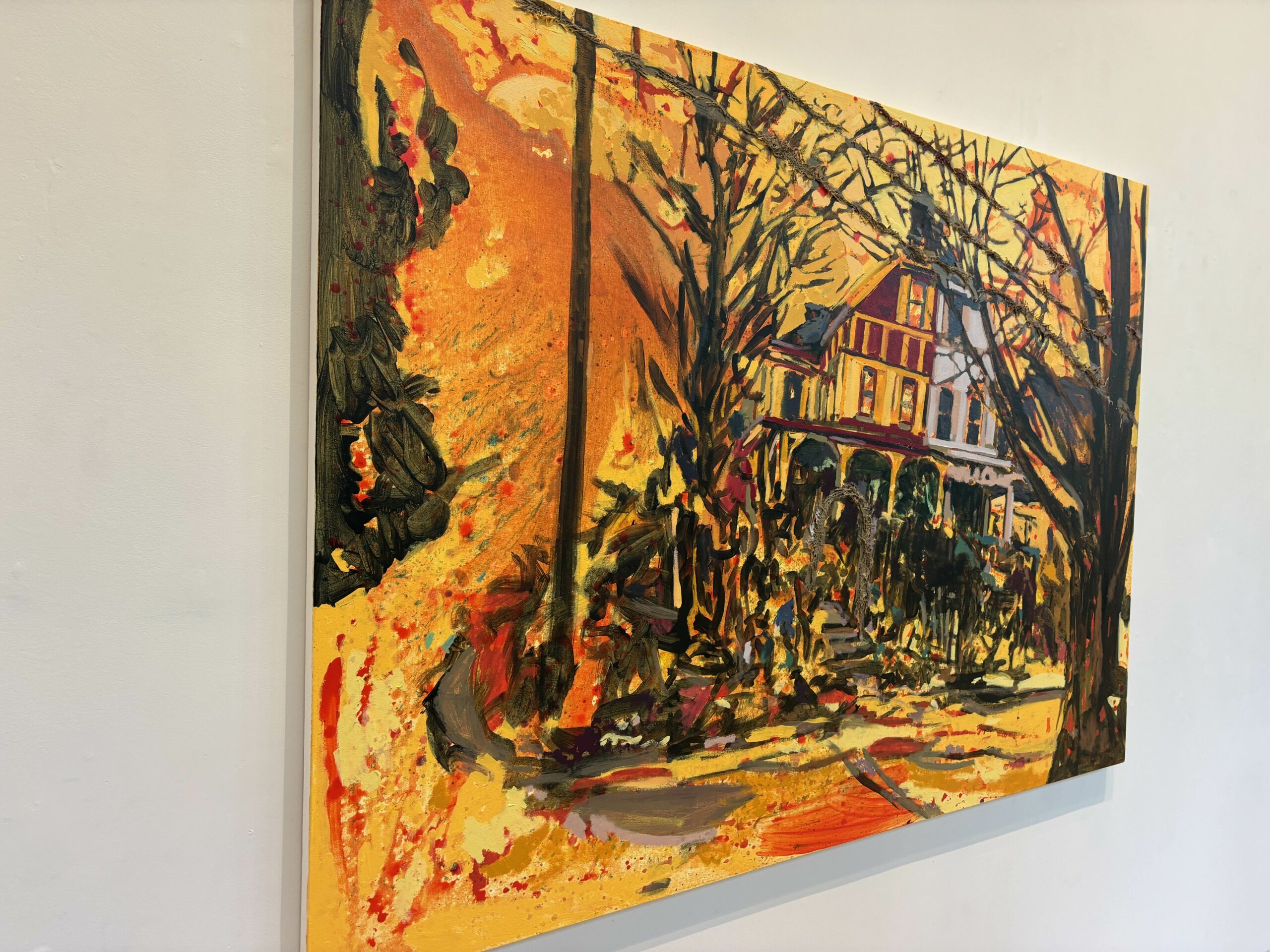
Image Credits: Emily Rutz
The true power of a painting is that it takes you somewhere else. When you look at the Mona Lisa, you don’t notice the swatches of paint, layer upon layer. You see the woman. In an art gallery, you’re looking at individual moments in time. You’re looking at stories, you see the tree before the canvas. This is what Professor Kristopher Benedict did in his exhibition, “Woolly Mammoth,” which I and a group of English majors had the honor of visiting with Dr. Eirini Panagiotidou, the chairwoman of the Ekphrasis Club that we were all a part of.
Kristopher Benedict is an art professor at West Chester University, a father and resident of Delaware County. He completed the 12 paintings and 26 drawings that comprise this exhibition during a year-long sabbatical. Four of these paintings were also part of an art show he did in July.
The main theme of the exhibition is, “looking back at your past and unburying it,” which made Benedict think back to his own childhood. “When I was a kid, my mom would take these night classes at the local community college, and there was a Mastodon skeleton in the lobby, and I would read a book or make drawings… while she was taking her classes. And I just had this image of… this Mastodon kind of skeleton.” The Mastodon was Sugar the Mastodon, found in Sugarloaf, New York, and he found himself connected to it.
Of course, there are no woolly mammoths or prehistoric creatures in any of the paintings — though Mastodons are one of Benedict’s many inspirations, as someone who previously worked at the New York Museum of Natural History while on a previous sabbatical. The exhibition title is meant to be a broad metaphor.
“A Woolly Mammoth is a catchy title,” says Benedict. “It’s like, if you’re gonna have an album, you know, like you’re a musician naming an album, you want it to be a little catchy.”
The real meaning of the title, however, is to represent the overarching scale of time and one’s personal connection to it. The woolly mammoth is also similar to an artist living in a world where some art forms are seen as extinct or devalued. “The woolly mammoth is an interesting character, but it’s… not super relevant, right?” Benedict remarks to the audience. “But you know, at the same time… you try to like, resuscitate them and they have unfrozen, you know, mammoth DNA, so maybe they’ll clone them. I don’t know. These things are on my mind, and I guess I don’t have a real, quick, easy answer for it.”
So we are met with nostalgia. We see a drawing of a mermaid, sitting on a giant seashell and blowing on a conch, reminiscent of hand-me-down storybooks from the 1930s. But there is always a catch: the shadows of the seashell look like a deadly spider, what a child could make out from patterns on a wall after the lights are turned off. It makes you wonder, is the mermaid calling for help? The first large painting we see upon entry, “Delco Twin,” is of a house surrounded by autumn, the sun setting in the western hills. The sunlight makes one part of the house look vibrant, but the untouched side reveals the true color of the house is gray. It reminded me of “Monster House,” a movie I watched as a child. It reminded me of Boo Radley’s house in “To Kill a Mockingbird,” fallen into reckless abandon and disrepair. To Benedict, it’s reminiscent of a Hitchcock movie.
My favorite of the paintings is a large one of dressed up children walking through snow — aptly titled, “Kids in the Snow”— all dressed up as magi. The tree branches are hanging down from the weight of the snow, layered over with burlap, as many of his paintings are. The atmosphere gives off a solemn air as children masquerade as adults on a holy mission, with one child in the center holding a staff with a flash of bright red. I can sense that in the world of the painting, the costumes are haphazardly put together from hand me down materials, possibly by a mother. It’s almost like they plan to leave their childhood behind.
Sometimes his paintings will start with an idea, but sometimes, they start with technique. They start with the color idea or the scale idea or the material idea. “I kind of see all the imagery as some kind of metaphor or analogy, or having some connection to this kind of story, of like, what does it mean to be an artist? How do you create?”
There was a large difference to him in working between the large paintings and the small drawings that he can just throw away upon making a mistake — though he loved having more time to focus on them. “In the past, drawings would be something that I would do kind of quickly as a study for a painting, right, or something that was sort of provisional that would lead to something else, but because I had more time… that just gave me superpowers when it came to drawing.”
In contrast, the largeness of the paintings are what drive the entire piece. “When I’m painting something big, I want to capitalize on the visuality… there are really impactful things that can happen from it.” He concentrates on making big shapes of color — focusing on “making something more extroverted and more visual happen”— followed by imagery.
All of the large paintings started with high saturated, acrylic washes, and then developed on their own before he found an imagery that would suffice. “Delco Twin” started out looking like a forest fire before he came up with the idea of the “weird, creepy house.” The large paintings came to him almost naturally, with him completing each one within a few months, whereas paintings like those would take a year pre-sabbatical. According to him, the artist is not motivated by the imagery as much as the balancing act of all the skills and techniques that make a painting.
Another theme of the gallery is, “the vagabond,” the wanderer that has either gone extinct or changed form, depending on your perspective. The exhibition begins with an image of a hobo, modeled after the image on the word’s wikipedia page. The hobo carries a stick with a bag connected to its end. The painting struck him and reminded him of the wanderer archetype. “There’s something about the way that paintings become psychological for me, the use of color, the way the surface kind of works, the way the imagery kind of changes, that makes me reflect on this role of the artist as being a little bit outside of, you know… the community or part of the community.”
One drawing of many, laying out on the table for onlookers to touch, depicts a homeless woman and her cat perching on her shoulder with a children’s playground superimposed from behind. The shades of purple that make up the painting contrast with the yellow mural on the wall behind. Another purple drawing features the duality of a medieval vagabond with a woman reading outside of where he went to undergrad. All of this makes him think about his role as the artist contrasted with the role of the viewer.
One of the large paintings, “Orange Plaza,” is not orange at all, but in shades of green. It depicts a crowded mall with a glass ceiling and a blooming tree in the center surrounded by benches. In the forefront of the painting is a man walking past with a shopping bag — maybe a vagabond himself. It was named Orange Plaza because it was the name of a mall in Orange County, New York, where he grew up. He found a photo of the mall, which was popular in the ‘80s, and he thought back to a time where he used to visit the mall, dimly lit and blasting loud music.
“They have a certain kind of atmosphere to them and they’ve gone extinct, you know, this was extinct in my time. By the time they opened up the fancier mall across town, this one was starting to go south… so these… interesting kind[s] of spaces that time forgot or jumped between different areas between paintings is something that I was sort of playing with in the show too.”
But, he doesn’t want to spell out all the themes for you. His favorite part of being an artist is resigning his say for the sake of keeping ambiguity. Though he is tempted with the idea of keeping full creative control, he will never tell you the full reason why he named the exhibition what it is. “I like the idea of the audience really determining… most of the meaning for themselves.”
The exhibition will be available for viewing in the Knauer Art Gallery (Swope 120) through Oct. 10, and his art can also be viewed on his website.
Emily Rutz is a second year English major and French minor. ER1034711@wcupa.edu