
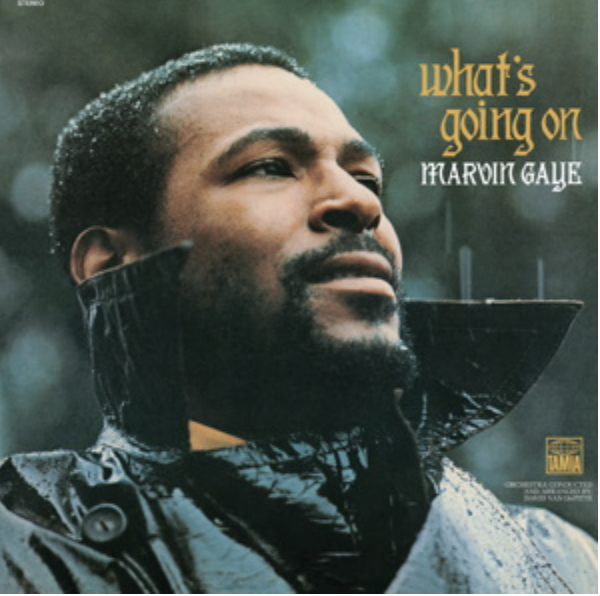
Image Credits: What’s Going On Album Cover
Marvin Gaye was a revolutionary vocalist whose projects continue to hold weight in music. His vocal skills combined with his melodic instrumentals and commanding lyrics make his artistry stand out to this day. One of his most recognized albums, “What’s Going On,” was an album that highlighted the divide in the world during the ‘70s. By framing his album around the Vietnam War, Civil Rights Movement, poverty and pollution, Gaye crafted a sonically beautiful album that unfortunately still deeply resonates today. This album proves that music and politics can intersect in a multi-generational way — speaking to the people and making musical history while doing so.
When “What’s Going On” was released in 1971, it marked a major shift for both Gaye and Motown Records. Known for love songs and catchy hits, Motown initially resisted the album, believing that it was too political for a mainstream audience. With Gaye’s personal connection and experiences of his brother being in Vietnam and social unrest quickly brewing across the United States, he decided to take the risk anyway. The album had groundbreaking success and proved that music rooted in activism could still bring success.
The themes of “What’s Going On” are hauntingly relevant to this day. In songs like “What’s Happening Brother,” Gaye addresses the struggles of veterans returning home after war to a country that is seemingly unrecognizable due to the divide in their country. This feeling is echoed today by veterans experiencing the same divide. “Inner City Blues (Make Me Wanna Holler)” paints a picture of economic hardship and systemic oppression which are themes that align with ongoing conversations about income inequality, housing crises and racial injustice. All the while, “Mercy Mercy Me (The Ecology)” was one of the first songs to highlight environmental destruction, which is a topic that has only grown more urgent in the face of rapid climate change. Listening to these tracks now, it is striking how little has changed. The problems Gaye sang about still weigh heavily on society, making the album feel less like a time capsule and more like an unfortunate prophecy.
Beyond the lyrics, Gaye’s artistry is what gives the album its staying power. His voice carries both grief and hope, allowing listeners to feel the weight of injustice while also imagining the possibility of unity. The layered harmonies make the songs beautiful to listen to, even as they grapple with painful truths. This balance of sound and substance is part of what makes “What’s Going On” timeless: it invites listeners in with the melody and keeps them thinking with message.
Gaye’s willingness to challenge industry norms paved the way for musicians to see art as activism, proving that protest can live, not only in the streets, but also on the charts. Younger generations, like myself, who discover “What’s Going On” today are often struck by how culturally significant it feels, reinforcing the idea that true artistry never expires, especially in a world resistant to evolve.
More than half a century after its release, “What’s Going On” still poses a question society struggles to answer. It reminds us that music is not only entertainment, but also a mirror, reflecting both our failures and hopes. Marvin Gaye’s voice continues to call out societal issues across decades, urging listeners to pay attention, empathize and act. The album is not only timeless in its sound, but in its pressing demand: to finally reckon with the same injustices that he named in 1971. Until then, his question remains unanswered and as relevant as ever, “what’s going on?”
Jazmyne Morgan is a fourth-year Philosophy major with a minor in Political Science. JM1001692@wcupa.edu
In biblical terms, prophets don’t just predict — they perceive. Marvin Gaye perceived the heart of humanity and held up a mirror. His art wasn’t entertainment; it was revelation. Jazmyne, thank you for this well written article about one of my favorite artists.