

Image Credits: Linda Huang via Wikipedia
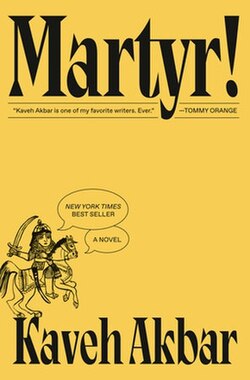
“Martyr!” by Kaveh Akbar has everything a reader would want: a nonlinear plotline, an edgy sense of humor and a pathetic main character. It’s also one hell of a literary debut.
We are thrown into the hilariously depressing life of Cyrus (Koroosh) Shams. In the present day, Cyrus is a 29-year-old Iranian-American ex-addict and failing poet, who works as a medical actor and lives with his Egyptian-Polish roommate, Zee. Fixated on the death of his mother, whose plane was shot down by the United States off the coast of the United Arab Emirates when he was a baby, the only thing Cyrus wants is to have a meaningful death: to be a martyr. So, when he finds out about a terminally ill Iranian artist who will be living in the Brooklyn Museum of Art until her death, he knows he has to go see her.
First of all, Cyrus is so pathetic it’s funny. The first actual chapter of the book made me laugh, though whether that was Akbar’s intention is unknown. This is where I learned what a medical actor is, and it is very entertaining. Under the comedy, though, is the bleak truth, and under the truth, there is hope.
Unreliable narrators are so fun to read, and it’s enjoyable to see someone be so wrong about his interpretation of himself and others. It serves as a good reminder that we can only make guesses based on what we can see. This is representative of Cyrus’s main flaw: he tries so hard to be right, but his trauma and anxiety make it hard. He overthinks in every wrong direction and comes to the worst conclusions. Meanwhile, the story circles through the perspectives of his late parents, his uncle and his roommate. Through this we learn the equally beautiful and tragic lessons of which he is unaware.
The tragedy of Cyrus is how disconnected he feels from everything. He is disconnected from his Iranian heritage, as he only has one living relative, he feels disconnected from the recovering addicts around him and he feels disconnected from the white people in his life due to their constant microaggressions. No one understands why he is obsessed with death, because they haven’t experienced the exact circumstances that made him an orphan. The disconnect is what makes him unable to understand his uncle, and why he is so disillusioned with the concept of martyrdom and meaningful death. It’s the small difference between the two regarding their proximity to death despite their similar circumstances that makes it so fascinating. The concept of everybody interacting with the same concepts but doing so differently is a big theme of the book.
Cyrus also feels disconnected from the concept of good, too. He doesn’t just want to be a martyr, but a good martyr, and as the book says, an “Earth Martyr.” But how can he be good when he thought of himself so badly, and for so long, as an addict?
Another underlying theme is what it means to be an American. Everyone around Cyrus is telling him he’s American and that connecting with his heritage is useless. But how can one be American when that is the country which killed his mother and whose people constantly microaggress and distrust him? And according to his mentor, how can he be Iranian when he was raised in an American culture?
All of this inner conflict within Cyrus is so real, and it’s part of what makes this book so poetic. It culminates not just with gorgeous prose thrown in amongst casual dialogue — most of which is highlighted in my copy — but with poems written by Cyrus scattered throughout the book, each about different martyrs throughout history. Admittedly, these poems are very vague, and occasionally the prose can be a bit flowery, feeling like they’re being added solely to give the reader another tearjerking line and to establish Akbar as a good writer. It is sometimes too beautiful and I wish Akbar could’ve taken it down a notch; it’s akin to eating too much sugar and having a stomachache. However, this bad habit is typical for one’s literary debut. There is no doubt Akbar will improve from here.
The book is a perfect length at 352 pages, though it is a lot. If all the nuances to Cyrus seem like a lot, then it must be noted that mentions of the side characters have been omitted. The side character exploration is fascinating, though readers have critiqued this as a flaw that makes the book too packed. They only add to everything in my opinion, though, and the twists change the way you will feel about this book completely.
Overall, this book is an astounding 9/10 must read and hopefully a future staple of American Literature. You will not regret reading this book!
Emily Rutz is a second-year English major and French minor. ER1034711@wcupa.edu