

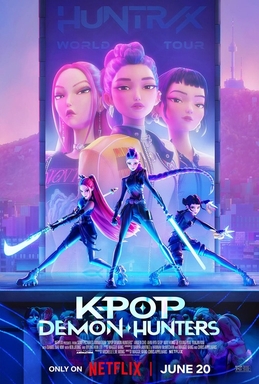
Image Credits: : Netflix and Sony Pictures Animations via Wikipedia
Ever since the short Disney and Pixar renaissance of 2020-2022, animated movies have been in a dry spell. There are popular movies here and there, but aside from “Across the Spiderverse” (2023), none have taken over the world the way “Encanto” (2021) and “Luca” (2021) did. Just when I was least expecting it, I see that this new K-Pop movie has completely enraptured the internet. Soon, all my friends are talking about it, and then it’s all I’m talking about. I never thought I’d be listening to a song from a children’s animated film on repeat, but that’s what “K-Pop Demon Hunters”(2025) does to a person.
“K-Pop Demon Hunters,” which debuted on Netflix on June 20, centers around Rumi (Arden Cho), the lead vocalist of K-Pop group “Hunter/X” and her bandmates, Mira (May Hong) and Zoey (Ji-Young Yoo). By day, they’re cooking up songs and filming music videos, but by night, they are hunting demons in order to maintain the Honmoon — the barrier between demons and humans — and saving humans from demons with the power of music as their predecessors have done before. Their plan is to turn the Honmoon golden in order to banish demons permanently. But their plans are interrupted by both Rumi’s failing voice and an up-and-coming demon boy band called The Saja Boys, led by frontman Jinu (Ahn- Hyo-seop), who are all trying to steal human souls through their voices.
There are an infinite number of things to like about this movie. The concept is just plain cool — I’ve seen plenty of fan works of demon hunters across the world and outside of Korea that make me very excited for the announced sequel. The songs are amazing — constantly on repeat — and the animation outclasses anything released recently. I adore the splashes of cartoonishness with the otherwise realistic animation style. The biggest selling point for me is how K-Pop is front and center. Recently, there has been a push for movies to branch away from niche topics and towards wider audiences, and I suspect any Disney executive would reject this movie the moment it was pitched. But all the K-Pop and references to idol culture and celebrity life is what makes this movie special. The “niche” topic definitely works — it’s the top Netflix movie of all time!
Some point out that it’s a sanitized version of K-Pop culture — and it 100% is, but I interpret it doing so in a way to inspire the industry going forward. The idols in this movie are encouraged to eat and rest, and the fans aren’t overly creepy — that’s the way it should be. It’s empowering seeing K-Pop idols being treated the way they deserve in an industry that is known to mistreat.
What makes “K-Pop Demon Hunters” an especially refreshing movie is the lack of archetypes that have plagued past animated movies. All three of the main characters are good at what they do and know it. I’ve seen a lack of that confidence in recent animated movies. Rumi is not the awkward and “adorkable” protagonist we are all used to (Rapunzel from “Tangled,” Mirabel from “Encanto,” Elsa from “Frozen,” etc). She is ambitious, thoughtful and serious. Jinu isn’t just a good-boy-gone-bad or a sheep-in-wolf’s-clothing, he is equally a compelling villain and love interest without sacrificing any of the depth and while subverting expectations. Mira and Zoey aren’t just sidekicks like the girls are in “Wish” (2023), they have fleshed out personalities and backstories just like Rumi. And they do this without making their backstories overly complicated. That reflects the general strength of the movie: it’s simple, starting on one concept and building on top of it, instead of leaving you with more questions. It doesn’t feel like they’re cramming everything into 90 minutes of screen time. The smaller cast of characters help with this, and they make sure they’re only on screen only when they need to be — like Celine— in a way that perfectly encapsulates the message of the movie.
While other recent movies have focused on family reconciliation, forgiveness and healing — which is by no means a bad thing — this movie focuses on found family and the right to make a new life for yourself and atone. All three main characters have found themselves either not fitting in with or being outright rejected by their biological families, and choose to find a home in each other. Despite that great bond they have, inwardly, they see their positions in the family as incredibly precarious and bound to fall apart with the smallest mistake. So they all choose to hide their flaws and anxieties from each other with the expectation that nothing actually important is being hidden. When Zoey and Mira pick up on a secret actually being hidden, they freak out under the assumption of imminent collapse. Ultimately, being open with each other is what brings the family back together. This resonates deeply with viewers who have been in similar circumstances and has a hopeful message: you can repair what is broken and choose a good life for yourself, and just because you make a mistake, it doesn’t mean it’s over.
Of course, the mistake of hiding your ‘flaws’ is paralleled with the absolute sin of being cruel to your family. And the film makes sure to distinguish between the two. Just because Rumi forgives Zoey and Mira for the way they initially reacted to her secret does not mean she has to forgive her mentally abusive adopted mother. Mira does not have to forgive her family either, nor do Jinu and Celine have to receive absolution for any of their actions towards their families. This is refreshing, because as much as I love familial healing, there needs to be reassurance that you are not bad for starting anew. You do not need to forgive or talk to people who have done you immense wrong, you can be with the family you created instead. But you are bad for selling out those who care for you the right way, like Jinu, and you don’t have to be forgiven to atone and choose good. While Jinu inevitably does, Celine is absent, which is incredibly realistic to real life. People don’t always change the way you want them to, and you never have to stay.
I don’t think it’s a perfect movie. The demon metaphor is a bit hard to apply to anything in real life without being a bit iffy — though nowhere near “Zootopia” levels of iffy — and I love having things fit neatly, one to one. I wish the scenes of the songs “Your Idol” and “This is What it Sounds Like” contained their entirety, as the scenes in their movie seem a bit rushed. I’m unsure if the movie’s development was crunched for time or not, but regardless I think the movie could’ve had another ten minutes or so, especially at the ending. Overall, the movie is an 8.5/10 must watch, and I’ll definitely be rewatching it again!
Emily Rutz is a second year English major and French minor. ER1034711@wcupa.edu