


Image: Angelina Jolie as Maria Callas in “Maria” (2024). Image courtesy of Netflix
The 33rd Annual Philadelphia Film Festival was hosted by the Philadelphia Film Society and ran from Oct. 17 through Oct. 27. Over the course of ten days I saw 17 films, ranging from documentaries to musicals to both at the same time. The power of film, as a form of protest, as a way to seek closure and reflect on the moment has never felt more palpable to me than in those ten days. 2024 and 2025 are going to represent a turning point for the industry — for the past decade, cinema as it once was has been rapidly dying. But from its corpse, mangled by franchises and nostalgia, more and more stories about that death are emerging and giving audiences a larger way to mourn off-screen deaths, big and small. From Generation X making peace with the new frontier of old age to humanity at large embracing the impending doom we’ve brought on ourselves through global warming, the reflection of our time through our art can’t lie: there are hard truths we must make peace with. And what better way to do that than through the magnitude of the movie screen?

“September 5” (2024) dir. Tim Fehlbaum
The opening night film was, unfortunately, my least favorite of the festival. “September 5” follows a team of ABC Sports broadcast journalists as they scramble to control the coverage of the Israeli Hostage Crisis at the 1972 Summer Olympics in Munich, Germany. In spite of gripping performances from stars John Magaro, Leonie Benesch and Ben Chaplin, what should have been a much more powerful film felt imprisoned by its own borders. The film aims to focus on journalistic ethics: the weight of being the ones to show a situation like this to the world as it unfolds. Where is the line between sensationalism and journalism? Whose story are you telling and why are you telling it? What is your responsibility, as a journalist and as a human being, when showing violence to the world? In execution, however, these questions miss their mark because the story never goes beyond the walls of the control room or beyond the day in question. The only historical context mentioned is the Holocaust, despite 1972 being three years before the end of the Vietnam War, the first fully televised war in history, which ABC itself sent reporters and camera crews to cover from the ground. The attempt to contain a story this big, with themes that big, leaves the film feeling shallow. Restraint can be a detriment, especially when making a movie about one of the biggest events in the history of television.

“Birdeater” (2023) dir. Jim Weir & Jack Clark
Australian cinema feels uniquely cursed. Every Australian film is a ghost story, and the ghost is a nameless, timeless violence that is baked into stolen soil. The best example of this, and perhaps the most well-known film to come out of the Outback, is the 1971 film “Wake In Fright,” about an English school teacher locked in a battle of civilization vs. savagery when he gets stranded in a small Australian town. “”Birdeater” has often been compared to “Wake In Fright,” but it’s an entirely different, special animal. It follows a man and his foreign fiancé as they travel with a group of friends to a remote house in the Australian wilderness for a “modern” bachelor party, which quickly descends into a surreal nightmare once booze, secrets and sex unleash the group’s inner demons. “Birdeater’s” female presence is its biggest strength — it’s what frees it from the shadow of “Wake In Fright” and allows it to carve its own place in the legacy of Aussie cinema. “Wake In Fright” is a battle of the sex, but “Birdeater” is a battle of the sexes. It points a finger towards the institution of marriage as just another war game, a ritual as bizarre as anything else you could do to a groom before his wedding day and, ultimately, the final tool of control for men and women to battle for dominance over. “Birdeater” stood out for me despite being in competition with some of the buzziest releases of the year because it demanded that attention. The hellish imagery, the performances from stars Shabana Azeez and Mackenzie Fearnley (as well as Ben Hunter, who walks the tightrope of unsettling and charming masterfully) and the overall screaming energy of the film make it shocking to me that this is Weir and Clarke’s debut feature. There are a lot of filmmakers who spend their whole careers trying to make something half as piercing as “Birdeater,” and these two managed to do it on their first swing.

“Anora” (2024) dir. Sean Baker
The “hooker with a heart of gold” trope is easy to pin down as an outdated cliché, but leave it to Sean Baker, known best for pushing cinematic boundaries through films such as “Tangerine” (2015) and “The Florida Project” (2017), to breathe new life and color to it in the form of “Anora.” Mikey Madison’s star power shines through in the titular role as a street-smart stripper who gets swept into a whirlwind romance with the son of a Russian billionaire. Madison’s charisma and sheer, uncompromised ability to bring the screen to its knees is what makes this film, but alongside Mark Eydelshteyn, she brings a vulnerability you never thought you’d see in a New Yorker. That vulnerability only makes the film’s sadder moments all the more heartbreaking, with a gut-punching final scene that left the audience sitting stunned in their seats before being surprised by an impromptu Q&A from Baker himself, zooming in between press events from the New York Film Festival. When an audience member asked him why he chose to end the film that way, Baker said “I try to do something that will leave the audience talking,” but I think he’ll find he made something that leaves them with no words at all. What begins as Gen Z’s “Pretty Woman” ultimately ends as Gen Z’s “Nights of Cabiria,” and in such cases, perhaps knocking the wind out of your audience is more powerful evidence that your story did its job than any words could.

“Maria” (2024) dir. Pablo Larraín
The third and (seemingly) final entry in Pablo Larraín’s trilogy of iconic women left me surprisingly upset, and not in the way it intended to. Admittedly, I’m not as familiar with the subject matter as I am with the deified stories of Diana Spencer and Jackie Kennedy, but despite that, I felt like the empathy Larraín had for the previous two women is gone here. “Maria” follows the last days of opera diva Maria Callas, recounting her life’s struggles as she succumbs to both mental and physical illnesses. Larraín’s direction shines as always; his rich imagery and lavish details are as always a feast for the eyes, but while they usually act as representations of gilded cages, here they only feel like an extension of Callas’ eccentricity, which removes a lot of the weight those opulent textures held in his previous projects. Jolie is stunning, but a performer is only as good as the material, and unfortunately, the script pushed Jolie’s performance closer to a parody of Norma Desmond in “Sunset Boulevard” than a tortured human being. What’s lacking is the presence of an institution. In “Jackie” (2016) it was the lion’s den of the White House, and in “Spencer” (2021) it was the suffocation of the Royal Family, but in “Maria”, the only battle the protagonist is fighting is against herself. Without an institution, what we are left with is watching a crazy drug addict talk to herself and stressing out her only companions as she wanders the streets of Paris. It borders on camp, and there is a subtle, snide cruelty in camp that makes “Maria” feel drastically different in tone from its predecessors in a way that disappointed me as a fan of Larraín’s style.

“The Brutalist” (2024) dir. Brady Corbet
The “White Whale” of this year, and what is being hailed as the rebirth of the great American epic, did not disappoint. Brady Corbet’s “The Brutalist” is a whopping 3-hour-and-55-minute-long grand spectacle, shot in VistaVision and presented to us on glorious 35mm. It’s hard to imagine seeing a story like this in any other way. “The Brutalist” follows Hungarian immigrant and holocaust survivor László Tóth as he uncovers the truth of the American dream when he catches the attention of an eccentric Doylestown, PA billionaire. “Monumental” has been the most common descriptor attached to this film, but despite its scope, it’s an incredibly interior movie. It’s hard to talk about it without mentioning its obvious forefather, Paul Thomas Anderson, and his work in redefining the epic as something that can apply to the personal as much as the spectacular. In its deep post-war colors, its orchestral montages, its emotionally baggaged lighting, you’ll find “The Brutalist” a singular, but much more grounded, film than it’s getting credit for. It’s a relic of an era of filmmaking that’s far behind us, but it’s not a circus act. The presence of the past is as emotionally relevant to the film and what it has to say about America — and more importantly, who is allowed to be an American — as its scope and width are. “The Brutalist” is a future American classic, not because it’s big, but because it’s true. And as much as we love a good spectacle, truth lasts longer.
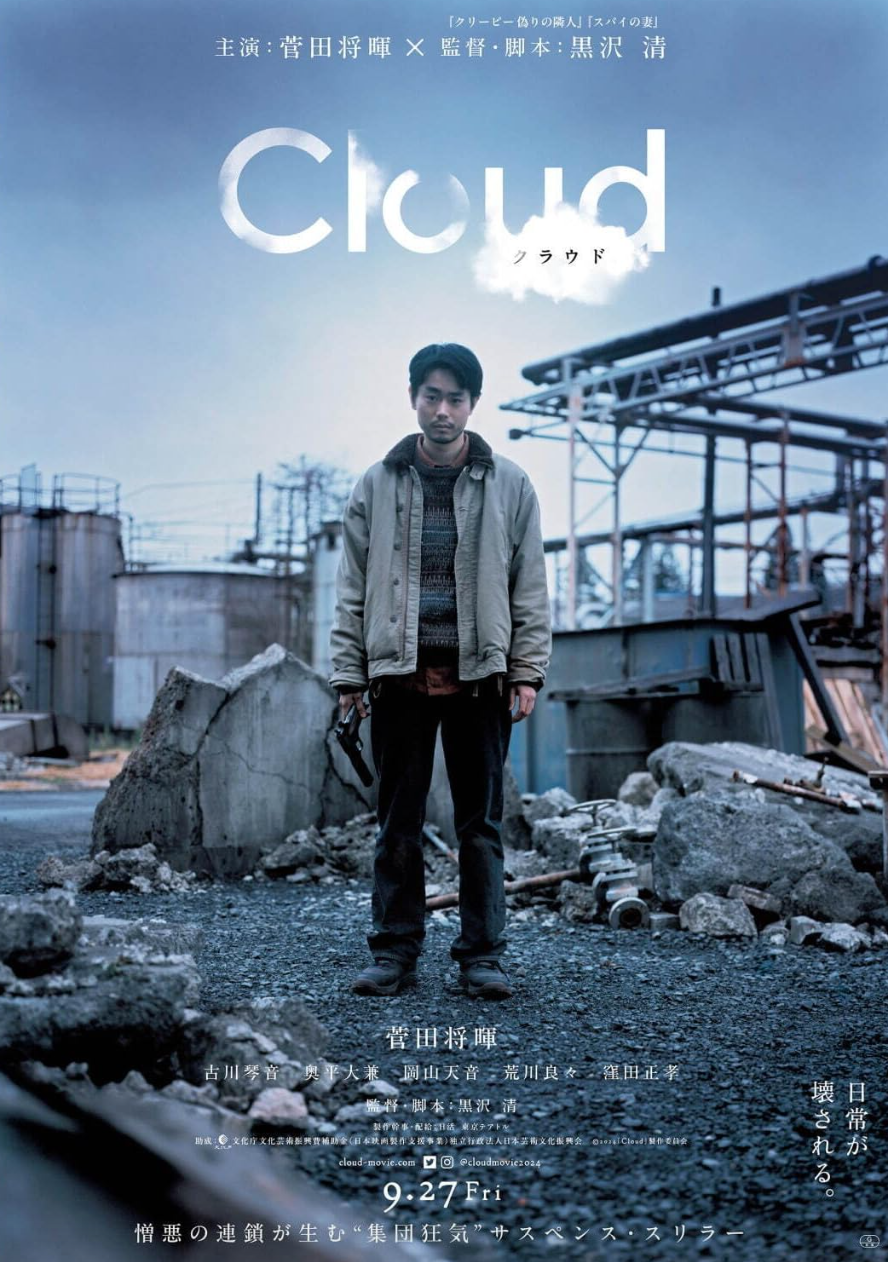
“Cloud” (2024) dir. Kiyoshi Kurosawa
When introducing “Cloud,” Philadelphia Film Society (PFS) Director of Programming Michael Lerman said that Kiyoshi Kurosawa is a filmmaker who needs no introduction. Alongside Junji Ito and Takashi Miike, Kurosawa is among the Japanese artists whose work has redefined modern horror. “Cloud” is no exception, demonstrating that even almost 30 years after his international breakout with “Cure” (1997), Kurosawa is still keeping audiences on their toes. “Cloud” follows an internet scammer whose karma finally catches up to him as people from his past start to return for revenge. Blending horror, thriller, action and comedy, “Cloud” continues Kurosawa’s tradition of using modern technology to represent human animus and the apathy of the information age. His ability to make the internet cinematic, a notoriously hard feat for filmmakers to accomplish, is as impressive now as it was 23 years ago when he made the revolutionary supernatural thriller “Pulse” (2001). Kurosawa’s fascination with applying humanity’s psychological sickness and attraction to violence to our increasingly inhuman digital world is exactly what makes “Cloud” work so well. He has an understanding of why we’re so drawn to our technology and how that connects to our need to hurt each other that few artists have, and that understanding has earned him and his work a rare spot in our modern canon, which “Cloud” should be joining shortly.

“No Other Land” (2024) dir. Basel Adra, Hamdan Ballal, Yuval Abraham, and Rachel Szor
It’s criminal and yet unsurprising that the most powerful film to be shown at the 33rd Philadelphia Film Festival still does not have an American distributor. “No Other Land” is a documentary about the displacement of the inhabitants of Masafer Yatta — a collection of villages in Occupied Palestinian territory — by the Israeli Occupation’s military and government. The film follows two young journalists, Basel Adra (Palestinian) and Yuval Abraham (Israeli), as they document the slow destruction of the region by the invading army and the resident’s efforts to protest. The power of “No Other Land” comes from how much of it is comprised of footage shot firsthand by Adra and Abraham. In this footage, you see the look in the eyes of children who are told they can’t go to school anymore because Israel needs to bulldoze it, the look in the eyes of a mother who cannot visit her disabled son in the hospital because Palestinians aren’t allowed to use the road anymore, the look in the eyes of Adra himself as Israeli settlers point assault rifles at him through the windows of his own house. In watching this film, you’re not only staring apartheid in the face, you’re staring at the pain it causes. Later in the festival, I stood in line with a woman who told me that, though she was a supporter of Israel, she did not know how to feel after watching “No Other Land.” This is why Israel is massacring Arab journalists like Adra and threatening Israelis who oppose apartheid like Abraham into submission: Because all it takes is one look into the eyes of the displaced families of Masafer Yatta to undo all of their work towards dehumanizing, subjugating and murdering Palestinians. That’s the power of documentation.

“A Real Pain” (2024) dir. Jesse Eisenberg
“A Real Pain” is a competent enough sophomore feature that was, for all of its drawbacks, ideal for a Sunday morning watch. It follows Jesse Eisenberg and Kieran Culkin as a pair of mismatched cousins traveling to Poland to honor their dead grandmother, leading to hilarious and emotional hijinks as their personalities clash across the tour. Most of the film was just fine — Eisenberg’s tightly-wound schtick warrants a lot of laughs as Culkin’s unhinged slacker pushes all of his buttons — but it ended up as a surprisingly effective lesson on the Holocaust. Having a Jewish writer/director clearly mattered a great deal, as the film goes to lengths to establish the magnitude of what the Nazi regime and genocide did: a montage of what were once the Jewish-owned businesses of a small town, since replaced or demolished; the last place a survivor lived before fleeing Poland turning out to just be a regular apartment building, still filled with tenants. Empathy is a recurring theme in the film, and in seeing what the Holocaust looked like outside the camps, you see how oppression is more than a death camp: it’s the total destruction of a life, of an identity. Eisenberg’s direction turned what would otherwise just be an alright “The Odd Couple” dramedy into something much more poignant.

“Audrey’s Children” (2024) dir. Ami Canaan Mann
When attending this screening, I did not know ahead of time that I was attending the world premiere of “Audrey’s Children.” But in doing so, I ended up with the experience of a lifetime, both as a lover of film and as a Philadelphia native. “Audrey’s Children” tells the story of Dr. Audrey Evans, a pediatric oncologist at the Children’s Hospital of Philadelphia (CHOP) who revolutionized cancer research, co-founded the Ronald McDonald house and blazed a trail for women in medicine. The audience was full of people who personally knew Evans, from coworkers to patients whose lives were saved by her work. Natalie Dormer’s performance was so moving that nearly everything she did onscreen warranted a “that was Audrey” from the woman sitting next to me, who I later learned was so close to Dr. Evans that she delivered her baby. Afterwards, during the Q&A with the cast and crew, audience members rushed to tell them that Dr. Evans saved their life, and to thank them for sharing her incredible story with the world. The cast and crew shared stories of loved ones affected by cancer, and in that moment, though I’d already been brought to tears multiple times by the film itself, I found myself crying again. “Audrey’s Children” is as much a love letter to the community of Philadelphia as it is to the amazing woman who touched it, and an extended hand of friendship to the global community of children affected by cancer. It isn’t until you’re sitting in a theater, surrounded by people whose lives were touched by the work Dr. Evans did, that you really feel the necessity of the biopic genre. These stories are more than just movies — to some people, they are one last thank you to a friend who changed their world.

“The Room Next Door” (2024) dir. Pedro Almodovar
Veteran filmmaker Pedro Almodovar’s first English feature does not feel like the work of a veteran filmmaker. The expertise of the framing, color symbolism and direction of stars Julianne Moore and Tilda Swinton all feel like the hallmarks of a seasoned artist, but the film’s understanding of the peace young people are having to make with the inevitability of death does not feel like it comes from a 75-year-old man. “The Room Next Door” follows a writer who is forced to face her fear of death when an old friend asks her to accompany her on a difficult journey. The movie is as much about empathy as it is death, about the few people still fighting for empathy in a world that seems to have accepted the cruelty of “the way things are.” The movie critiques neoliberalism, evangelism and the failures of our medical and legal systems while the threat of global warming lurks overhead. Almodovar began his career making “current” art, and half a century later, he is still making art as reflective of society’s issues as it was 50 years ago. However, his art has changed in its tenderness. His relationships have graduated from the psychosexual to the intimate in a different, subtler way, appealing to our kinder urges more than our darker ones. “The Room Next Door” feels like one of the many harbingers of transition I saw at the festival. It is a glimpse at what the future of cinema has in store for us. The next decade of cinema is going to be defined by stories not just about accepting the inevitable, but about learning to still care in the face of it.

“The Seed Of The Sacred Fig” (2024) dir. Mohammad Rasoulof
While its power stands on its own, I also feel like backstory is necessary in explaining why “The Seed of the Sacred Fig” is so special. Mohammad Rasoulof is an independent Iranian filmmaker whose work has been deemed offensive to the dictatorship that dominates Iran. He has been jailed countless times for his art. This film was shot in secret, starring real life activists set against the backdrop of the unrest created by Iranian women’s rights protester Mahsa Amini’s death in police custody. It follows Iman, the patriarch of an Iranian family who works as an investigator for the Iranian Regime. When his gun goes missing during a time of political turmoil, the family begins to unravel and turn on each other as the misogyny and oppression of the Iranian regime seeps into the family’s dynamic. In what was my favorite screenplay of the year, the story unfolds with such an intensity that you will be gripping your seat by the time the climax sets in. Missagh Zareh and Sohelia Golestani’s performances as conflicted parents struggling between loyalty to their status and the simple desire to give their daughters the happiness they deserve were the best of the year (it is worth mentioning that both actors have not been granted permission by their government to promote the film; as of now their whereabouts are unknown). The situation in Iran since the 2022 unrest that the film depicts has been described as a “quiet revolution.” This film is an extension of that revolution. It is a work of art so important its director/writer, crew and a portion of its cast had to flee on foot after making it. That speaks for itself.

“All We Imagine As Light” (2024) dir. Payal Kapadia
“All We Imagine As Light” is another addition to India’s rich history of slow cinema, films that take time to breathe. It follows a group of nurses living in Mumbai, juxtaposing the hectic inequalities of city life with the quiet freedoms of the countryside. Its imagery lingers: on the fireworks shot off above the city, on the sweat on a lover’s skin, on the waves as they crash against the beach. Slow cinema has a certain weight to it that can’t be felt through more rapid storytelling. To allow your audience to take in what they’re watching is to allow them to feel your story as deeply as they possibly can. “All We Imagine As Light” was felt with that depth, inhaled and savored and cared for. If you enjoy the works of Satyajit Ray or Yasujiro Ozu, the way their domestic dramas wash over you like rain, “All We Imagine As Light” will leave you floating in that same sensation, and draw you into the depths of its contemplative storytelling in the same way.

“The Last Showgirl” (2024) dir. Gia Coppola
Vegas is the epicenter of death. It has always had a haunting, tragic quality to it. But as more and more of its institutions are leveled, glitter and color replaced with soulless beige, that sense of death has grown bigger and bigger, and soon it will swallow the town whole. Gia Coppola taps into that impending death in “The Last Showgirl,” starring Pamela Anderson as an aging Vegas dancer who is forced to confront a world that has left her behind after her 30-year-running show abruptly closes. Anderson’s performance is so complex, at times making the audience loathe her character as much we pity her. It’s rare to see a female character depicted as both sympathetic and unforgivable, and Anderson does not hesitate to sink her teeth into this meaty and layered role. Coppola shoots Vegas with a pastel decay that’s only fitting for a story about Generation X’s transition from middle age to what comes after. Even the cheap and hollow spectacles of yesteryear look magical next to a modern world that doesn’t respect personality. The colors and lights that fade from the Vegas strip are just another death in a long series of deaths we must make peace with. But the inevitability of them fading out doesn’t make living in a world without sparkle, or security, any more tolerable.

“The Order” (2024) dir. Justin Kurzel
“The Order” is an average but stunningly-shot genre piece about the true story of an FBI agent’s quest to stop a white supremacist plot to overthrow the U.S. government. Jude Law, Nicholas Hoult, Tye Sheridan and Jurnee Smollett line the cast and deliver performances worthy of their star power, but the film succumbs to an all-too-common issue in depicting domestic terrorism in film: it presents the police as an apolitical entity. The film aims to draw parallels between the Jan. 6 Insurrection and its subject matter, but forgets that the police were a necessary part of that event. They’re depicted on video opening doors and standing aside as right wing mobs storm the Capitol. In telling stories like that of “The Order,” it’s important to remember that beliefs can extend beyond badges. The movie features breathtaking cinematography, but to what end? The beautiful camerawork, engrossing performances and gripping pace are overshadowed by the elephant in the room.

“The End” (2024) dir. Joshua Oppenheimer
On paper it’s hard to imagine a musical about post-apocalyptic survivor’s guilt, but in a post “Annette” (2021) world, the boundaries of our musical imagination don’t matter anymore, not with visionaries like Joshua Oppenheimer behind the camera. “The End” follows a wealthy family as they live out their days in an underground compound after climate change caused by the very things that gave them their wealth has made the world uninhabitable. Through music, the struggles of these reprehensible people shake your soul. Through song, they beg for forgiveness they cannot give themselves, bury their heads in the sand or try to cling to normalcy in a world they’ve robbed of normal, and in their soliloquies you can’t find the heart to tell them that some people don’t deserve forgiveness. In the week since I first heard it, a lyric has kept ringing through my head. “Back when how many nights we might have left didn’t matter much at all.” I cannot stop thinking about it, and about how our present is reflected in our future. Are we doomed to keep our pre-apocalyptic performance of normalcy up forever, even after normal is gone? Will we really never learn from our mistakes? Can we be forgiven for what we selfishly sacrifice? Oppenheimer’s film and music will leave those questions burning a hole in your mind long after you’ve left the theater, a burning which will likely only grow hotter when you step outside to feel another abnormally hot fall slide into another abnormally hot winter.

“Pavements” (2024) dir. Alex Ross Perry
A documentary about the band Pavement, an iconic fixture of the early 90’s indie scene. A broadway musical featuring the music of Pavement, a band your dad probably liked when he was your age. An Oscar-worthy biopic about five incompetent suburbanites who got mud hurled at them by an angry mob in West Virginia. Alex Ross Perry’s new film, “Pavements,” is all three of these things, and then some. Mixing a multitude of projects together for one big monument to America’s favorite slacker band, “Pavements” is unlike any documentary you’ve ever seen before, because, well… it isn’t one. But it is one. But not really. Yes, no, and everything in between. Something so contradictory is only fitting for the band that doesn’t care. Joe Keery, Fred Hechinger, Logan Miller and Natt Wolf show up to play both fictionalized versions of themselves and fictionalized versions of the band as the film takes us through the history of Pavement while simultaneously poking fun at “Bohemian Rhapsody,” “American Idiot,” and other kinds of try-hard ass-kissing the band emphasized they did not want to see from filmmaker Alex Ross Perry. He listened and instead gave them a movie that is incomparable to any other legacy monument for any other act. “Pavements” is as unique, charmingly smarmy and enjoyably up-its-own-ass as Pavement itself.

“Blitz” (2024) dir. Steve Mcqueen
The festival’s closing night feature ended up a lot more musical than I expected. Billed as its own riff on the Pinocchio story, “Blitz” follows a boy named George as he traverses WWII era London on a quest to reunite with his mother. Saoirse Ronan playing a mother is a bit jarring at first, as it’s still hard to not look at her and see Lady Bird, but she has a warmth and life in the role that makes you grip your seat in hope that she’s reunited with her son. She also displays a surprising talent at both song and dance, and McQueen’s fluid camerawork lends itself beautifully to those sequences, moving almost as rhythmically as the swing steps it tracks. The film may be a bit pedestrian, especially by McQueen’s standards, but it’s hard to not get sucked into its simplicity. It walks the tightrope of whimsy and fear in a way that feels inspired by the children’s films of the 1980’s. Danger and adventure walk hand in hand as George runs through the firebombed streets of London. The film has a limited theatrical release beginning Nov. 1 but will be widely available through Apple TV on Nov. 22. Considering the film is such a reminder of another era, where movies like this were the rule and not the exception, it’s a shame it won’t be getting a wider theatrical release before dumping itself on streaming. It’s hard to imagine a television doing this sound design as much justice as the theater would.
The festival came to a close on Sunday, Oct. 27, when it announced its jury and audience award winners. Among them were “Audrey’s Children,” which won the Filmadelphia Audience Award, and “Birdeater,” which received a Jury honorable mention for Exceptional First Feature. One of the most successful festivals to date for the Philadelphia Film Society, the 33rd Annual Philadelphia Film Festival’s diverse range of films showed me a glimpse of film’s magnitude as an art form. Movies can connect, rebel, make fun, shine new lights, break your heart or open your eyes. I feel overwhelmingly grateful that a community so dedicated to sharing that magnitude with the world is right here in Pennsylvania. Thank you to the Philadelphia Film Society for making your screens feel like they’re big enough for all of us.
Elijah Fischer is a third-year English and Media & Culture major.