

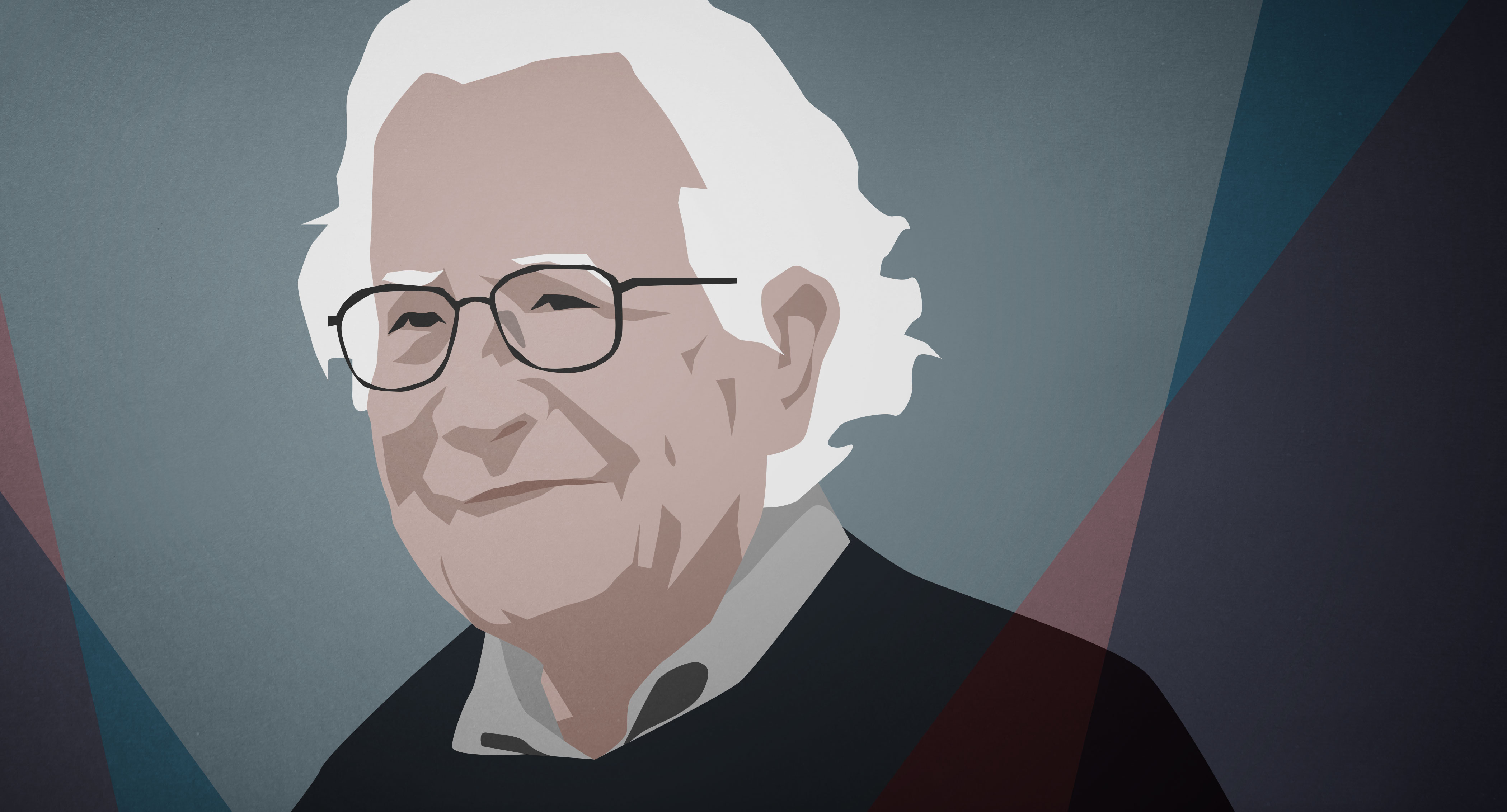
Photo: “Noam Chomsky” by Jared Rodriguez via Flickr
Last Thursday evening, famed intellectual and political dissident Dr. Noam Chomsky gave a talk via video-chat at West Chester University. Those unfamiliar with Chomsky may wish to read the article in the Op-Ed section, which provides a profile of him and his intellectual legacy so far. An audience of several hundred students and faculty filled the Madeleine Wing Adler Theatre, far from empty, but still comfortably not entirely full.
The audience chattered with anticipation—those unfamiliar with Chomsky wondered what he would talk about, and those acquainted with his ideas ready for a scathing critique of global society. Soon after he appeared on the large projector screen, after the generous introduction and applause, Chomsky began, as he often does in his speaking engagements, to vividly describe how horrible our political climate is, as well as warn us of the impending doom we will all surely face in the very near future.
Beginning with a short history of the Doomsday Clock, a symbolic measure of how close we are to extinction-level nuclear conflict, Chomsky notes that we are currently two minutes to midnight, tied with 1953 as the closest year we have been to total annihilation. Not to be insufficiently pessimistic, Chomsky also made sure to tell the audience that regardless of any advancement in nuclear peace, this generation has the cataclysmic climate crisis, rising acceptance of fascism, global imperialist proxy wars between the U.S. and China/Russia and the proliferation of surveillance capitalism to look forward to. Chomsky did not mince any words, as usual, and made clear his framework for the solution to these many issues, primarily the spreading and maintenance of a healthy democracy and the fight against capitalism and corporate greed.
As apocalyptic and powerful his words and messages are, Chomsky spoke in his familiarly soft voice, as if he were talking with a friend about the weather (which he was, in a way, by mentioning the increasing global temperatures which resulted from climate change). His calm manner seemed to have entertained some of the audience members, hearing a cataclysmic prophecy that would sound more fitting yelled through a megaphone in a town square with a picket sign, or perhaps from podium on a debate stage.
After a short but content-packed 20-minute rant, the floor was opened for questions, which was fortunate as Chomsky had plenty to say about every question on the floor. Although his responses were quite rambly and went off many different tangents, they were filled with interesting information one may not find without in-depth research into a niche field, which is something Chomsky has done for most of his life. Questions of climate change action, left unity, human nature and gun control each spiraled off into mini lectures; often into seemingly unrelated topics, but still contained answers buried within the massive onslaught of information Chomsky commands from his immediate memory.
While known for his radical political ideals, Chomsky seemed to have embraced real-politik more than he did in his earlier, more idealistic years. Geo-politics and American imperialism dominated much of his expansive writing output, but Chomsky has reoriented his view of what is the most important front to fight in the political battlefield. Chomsky, a self-described anarchist, admitted when he answered an audience question that, while he desires foundational institutional change toward a truly free and democratic society, the world simply cannot wait for such changes to take place before either some country launches nuclear warheads or all of the polar ice caps melt.
Despite his pessimism of the current political climate, there was an echo of optimism that permeated through Chomsky’s responses to the students’ questions. While Chomsky takes the corruption of government institutions by capitalism as a given, Chomsky still has hope for the generation of young people today to make their own change through grassroots organizations and parallel political movements. Chomsky stated that this will be the primary driver of larger social change. Trying to bring down the current political system by just voting for people to change it from within has led to a hotbed of corruption with money in politics, but Chomsky notes that even the most powerful institutions can be swayed social and cultural changes that begin with a grassroots movement.
Furthermore, Chomsky has a strong trust in the younger generations. When asked by an audience member a piece of advice Chomsky had for him in how to confront the world’s issues, Chomsky basically declined to answer, instead saying that young people don’t need the advice of old people who may look down on them, that instead they should simply know the problems they want to solve and follow their own path. Perhaps as bitter as he may be about the world today, Chomsky’s radical spirit is still there in the form of hope for our generation.
Alexander Habbart is a fourth-year student majoring in math and philosophy. AH855541@wcupa.edu