

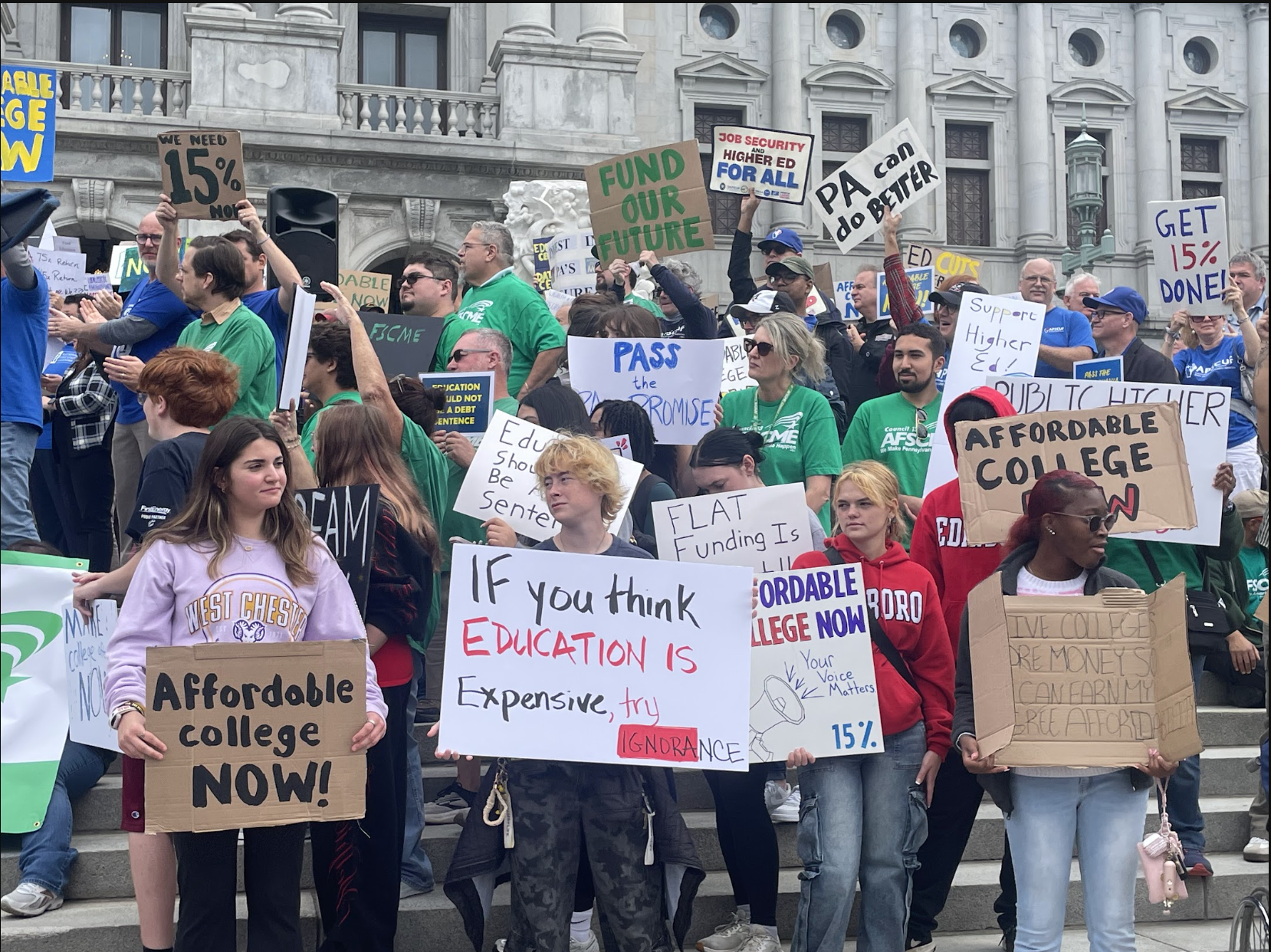
Image Credits: Elijah Fischer
At the foot of Pennsylvania’s state capitol building, inconspicuously etched into a bench towards the bottom of its steps, reads a quote from American revolutionary Benjamin Rush: “Freedom can only exist in the society of knowledge.”
As students and faculty from schools across the commonwealth flooded the steps above Rush’s words, bearing signs that read “fund our future” and “education should not be a debt sentence,” it only made the founding father’s point stand clearer when echoed by young Pennsylvanians of today fighting for their right to learn.
On Sept. 28, the “Affordable College Now!” rally brought a coalition of schools from across the PASSHE system to the Capitol Complex in Harrisburg, PA, where they demonstrated in support of a 15% increase in state funding for higher education. Among the schools represented at the rally was West Chester University, whose branch of the Association of Pennsylvania State College and University Faculties (APSCUF) organized a bus to transport students, faculty and staff to the state capitol.
The rally saw dozens of professors, students, union leaders and even state representatives speak in support of increasing funding for higher education. This included the endorsement of the PA Promise, a scholarship program that would provide debt relief for students with an annual household income of less than $250,000.
Dr. Chris Stangl, President of West Chester University’s APSCUF branch, said that “All 14 chapters of APSCUF were in agreement that this rally was necessary… The understanding is that education is a public good funded by the taxpayers, so anytime tuition goes up and the allocation from the state doesn’t, it makes it more of a private system, because now it’s students paying instead of the taxpayers.”
For the 2026-2027 school year, PASSHE raised its tuition costs by $172 per semester. Should they not receive the 15% state funding increase, a potential 4.3% rise in tuition is on the table.
Stangl, who is Chair of the Political Science department, discussed the effects that might have on WCU’s student body. “The issue of increased expenses is especially pronounced here at West Chester, given the cost of housing…We’ve got students working 20-30 hours a week, already struggling to balance that with classes.” Stangl also brought up the potential for a future faculty strike arising from state funding troubles, mirroring the union’s 2016 strike which brought classes to a halt for three days. “The future of APSCUF’s contract has a lot to do with state funding,” Stangl said. “These are all related issues, so our solidarity with our students is irrefutable.”
Natalie Trzaskawka, Adrienne Thomas and Anna Yowler, three WCU freshmen all majoring in education, joined the rally in hopes of making student voices heard. “Tuition really impacts the rest of your future, not just your four years here [at West Chester], because you’ll be paying [loans off] for a really long time. I’m still in my first year; an increase in tuition would add up quickly for me.” Trzaskawa said.
West Chester University depends on state funding as a PASSHE school, and without a funding increase, students worry that the already steep costs of college life will become untenable. “You’re trying to find housing, you’re trying to plan for the future, you don’t want to have to worry about an increase in tuition.” Yowler agreed.
Thomas, who comes from a single-parent household, raised concerns about how the burdens of debt will affect groups like first-generation students, who lack a safety net to protect them from rising costs. “As a future teacher,” Yowler said, “I want my students to feel like an education is something worth having regardless of their financial situation.”
Ian Hall, a senior at PennWest Edinboro who is also pursuing a future as an educator, was one of the rally’s student speakers. Later, he spoke with The Quad’s reporters on his reasons for using his voice. “I believe everyone deserves access to higher education. One of my roommates last year dropped out because he could no longer afford to go to school.”
According to Hall, he isn’t the only one. “I’ve started to slowly notice my class getting smaller and smaller as I get higher and higher up. [When I first started my major] there were about eight of us; since then, five other people have dropped out.” Hall is majoring in secondary education with a specialization in mathematics.
“Of the almost 80,000 students within the PASSHE system, the 15% increase in state funding would save all of them about $1,100 a year,” Hall said. “Saving $4,400 over four years of higher ed would make a huge difference because people have to take out loans, and those loans accrue interest over time; it creates a mountain of debt that people don’t really see at first. So just knocking off that $4,400 could save students tens of thousands of dollars in the long term.”
Following the rally, students had the opportunity to meet with state legislators and their teams to make their case in support of the 15% increase. Trzaskawka, Thomas, Yowler and other West Chester students met with Marc Collazo, Chief of Staff to Sen. Joe Picozzi. Picozzi, the son of a special education teacher who counts “improving education” among his legislative priorities, has advocated for state funding increases towards the sector in the past but has yet to publicly endorse the 15% increase towards higher education or the PA promise bill.
“I think talking to them, having them understand what’s going on, that allows for more change,” Trzaskawka said of the experience. “I hope he passes it on,” Yowler said, “because I feel like it’s easy to say ‘oh, the kids don’t want to pay for college’, but it’s more than that. We don’t want to be exhausted because we’re working two or three jobs while trying to go to school. If what we said actually gets shared, then that would make me heard.”
Elijah Fischer is a senior majoring in English with minors in Journalism and Film Criticism. Af997636@wcupa.edu.