
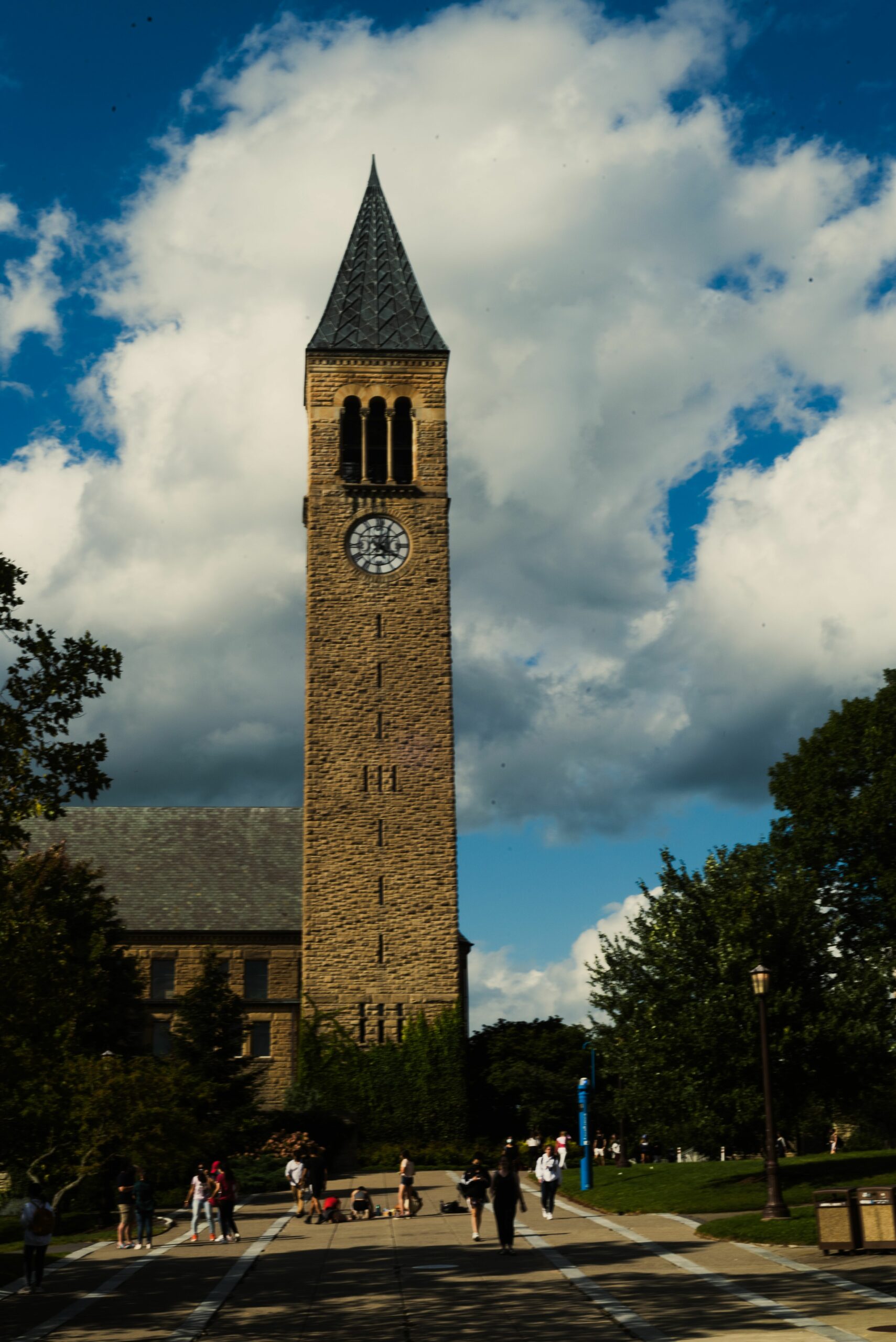
Image Credits: David Yu – Pexels
An investigation has recently opened back up at Cornell University about how a former student (Jane Doe) filed a civil lawsuit against seven former Chi Phi members, the university, several other organizations and individuals due to an alleged sexual assault at the Chi Phi fraternity house in Oct. 2024.
The case has gained a significant amount of attention after the Tompkins County District Attorney’s Office announced it would reopen its criminal investigation and present evidence to a grand jury.
What allegedly happened?
According to the lawsuit, Doe, who was 20 years old at the time, attended Cornell’s Chi Phi fraternity house in Oct. 2024 while being severely intoxicated. She alleges that two fraternity members pressured her into taking what they said was ketamine before sexually assaulting her.
The lawsuit also claims that around 1:42 a.m., a fraternity member sent a message to a group chat on Snapchat with the other Chi Phi brothers suggesting “free pussy.” She then alleges that more men eventually entered the room and that the assaults continued for several hours.
About three weeks later, Doe reported the incident to the Cornell University Police. According to a transcript of her interview with campus police by CBS News New York, she said that she had been drinking and using drugs that night and had gaps in her memory of what had happened. While she described some of the earlier sexual activity as consensual, she said that what happened after was not.
“I can say with 100% confidence I was raped,” Doe told campus police, according to the transcript.
What did Cornell do about the incident?
The university launched a Title IX investigation after Doe reported the incident. According to Cornell President Michael Kotlikoff, two of the accused students were expelled, two were suspended for at least two semesters, one had already graduated before any action could be taken and two were not found responsible for sexual misconduct.
Cornell has also decided that writing essays was the best way to punish the accused students.
The Chi Phi chapter was forced to close in 2024 and is barred from Cornell’s campus.
Cornell tried defending how they handled the case, saying the investigation included hearings where both Doe and the accused students were able to testify and give evidence: “Any suggestion that the university did not impose consequential punishments for those involved is false,” Cornell said in a statement.
New York Gov. Kathy Hochul announced on Sept. 30 that Cornell also agreed to bring in outside counsel to conduct an independent investigation into it.
Why is Doe suing Cornell?
Long story short, Doe’s lawsuit accuses Cornell and other defendants of negligence, breach of contract and violations of state law. She argues that Cornell failed to protect students from sexual violence and properly oversee the organizations involved.
Why is the criminal investigation being reopened?
The Tompkins County District Attorney’s Office originally decided not to bring forth criminal charges in 2024, saying that “there was insufficient evidence to support criminal charges.”
District Attorney Matthew Van Houten said the statement his office received at the time described Doe’s participation in the drug use and sexual activity differently from the allegations made later in her civil lawsuit. However, Van Houten told CBS News that his office never got the complete transcript of Doe’s interviews with the Cornell police, specifically including her statement in which she said she was raped: “I never saw it, never heard it until tonight. If it exists, I will get it. You can be sure of that.”
Houten has reopened the investigation and plans to present the evidence to the grand jury. However, as of Oct. 1, Hochul appointed New York Attorney General Letitia James as a special prosecutor in the case. She will investigate the incident and, if warranted, prosecute offenses and present evidence to a grand jury.
Doe’s attorney, Thomas Giuffra, criticized the original investigation, basically saying that Doe was never even interviewed by investigators from the district attorney’s office. Cornell, however, says its police department provided the results of its investigation to the DA.
What have the accused students said?
The attorneys for some of the former fraternity members have denied the allegations.
Jeremy Saland, an attorney representing former Chi Phi member Scott Kretzchmar, acknowledged that the Snapchat messages from the night of the assault were inappropriate but argued that they don’t prove any sexual assault. He said his client briefly entered the room but didn’t have any physical contact with Doe:
“This is a situation where there was an ugly Snapchat — ugly, period,” Saland told CBS News. “But that doesn’t make my client a rapist, and it certainly doesn’t make anyone a sex offender.”
Another attorney, Andrew Miltenberg, representing another defendant, Gillio Lopes, said his client “unequivocally denies the allegations against him.” Miltenberg also argued that the allegations now being made publicly don’t match what Cornell investigated previously.
How are people reacting?
Many individuals, including fellow Cornell students, alumni and staff, are outraged by how the university handled the incident. Many have posted statements and videos about the matter all over social media about how they are deeply disappointed, and along with this, Cornell has also turned off/limited the comments on all their social media platforms. Just recently, a Cornell student held a campus town hall event to discuss what happened and admitted that the university is “complicit in rape culture — in Greek life and outside of it.”
As the investigation continues, questions still remain about how Cornell handled the allegations and what the case could mean for the future of the university.
Madison Shrift is a third-year Communication Studies major with a minor in Media & Culture. MS1040447@wcupa.edu.