

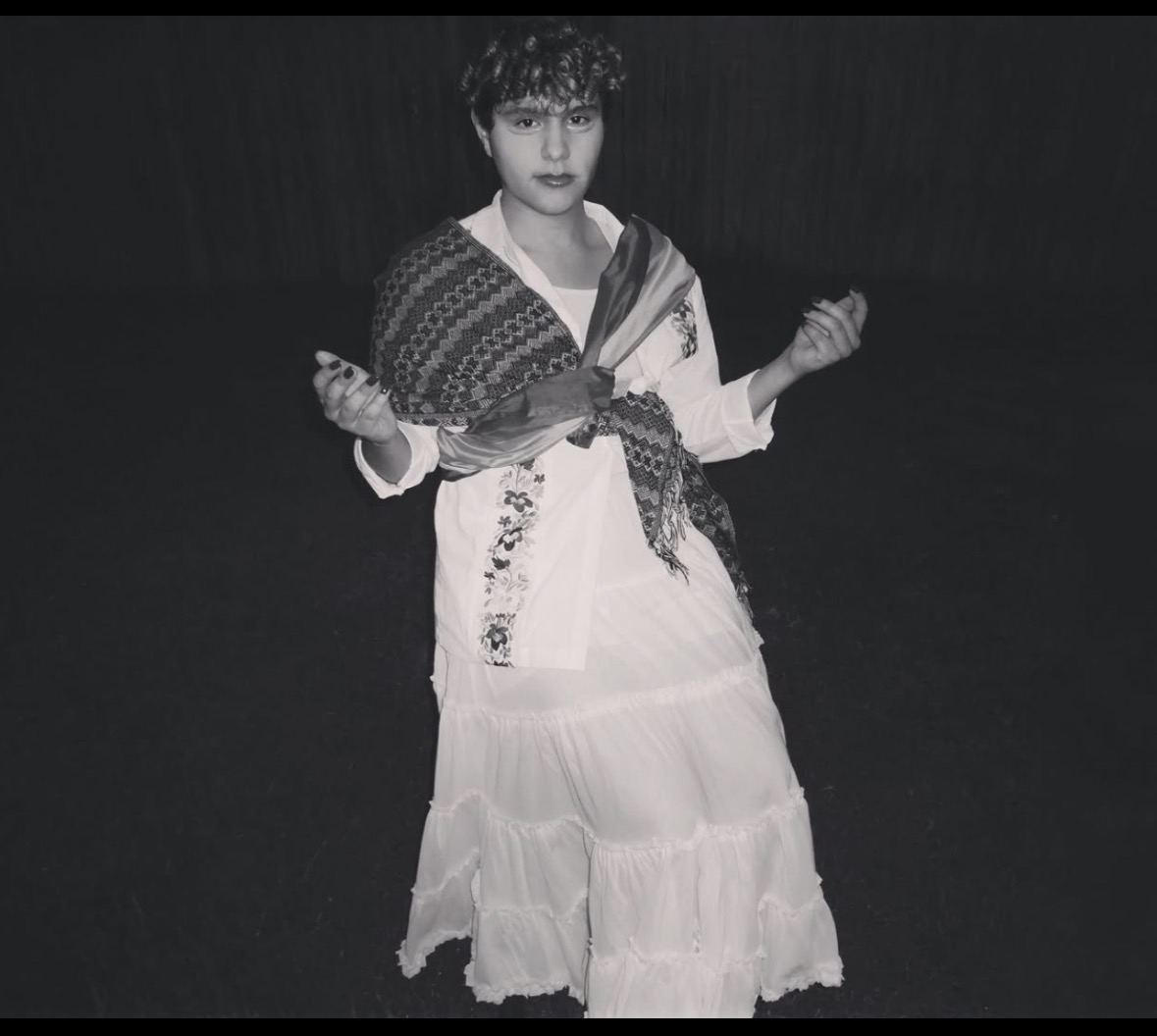
Image Credits: Elwim
West Chester University Doctoral Student Elwim E. Sorto has done it all. Whether it is journalism, creative writing, photography or queer advocacy, Sorto has refused to be put in a box. He even served in the National Guard as a human resource specialist!
Hailing from and based in Dallas, Texas, Elwim is first-generation Salvadoran American and finds it important to share his culture, especially during Hispanic Heritage Month. “Being first gen,” Elwim starts, “can be very daunting when you’re trying to, you know, make something out of yourself. So… within that, I’ve been able to go ahead and increase my education from an associate’s degree to a bachelor’s to a master’s in social work.”
Growing up, being first-generation meant a lot to Elwim. His father came to the United States after the El Salvadoran Civil War, and he and his family had to adapt due to the different kinds of education his parents had received compared to Elwim. “I just really feel it’s a learning process because my parents, they couldn’t even graduate high school… or middle school or elementary school. It’s… a system that you just try to navigate. And, you know, you feel lonely a lot of the time and you put the intersections of mental health and being queer and all those things, and sometimes your family just doesn’t understand you.”
Despite his parents struggling to understand, they have been a huge support to Elwim through his journey. “After I came out [as gay] in my late teen years… Definitely something switched on them because they were like, ‘All right, so… it’s not like I’m gonna throw you away,’” Sorto recalls. “So they really tried to understand that their perceivement of what I was supposed to look like when I was older isn’t necessarily what they were gonna get. And that, you know, whatever I go ahead and do, they know that I do it with a good cause in mind.”
Elwim got his associate’s degree in science during high school, a testament to him being a hard worker from the start, and received his bachelor’s degree in social work at University of Texas at Arlington. During his undergraduate degree, he noticed there was a gap in care in extracurricular activities: There was no club for queer social work.
Now, he’s getting his doctorate in Public Administration online, and is continuing his activism from undergrad at West Chester University. “There’s an own specific culture and type of care that you’re supposed to go ahead and give LGBTQ+ individuals,” says Elwim. “And so I saw a gap,” Sorto explains. “ So I was able to go ahead and establish the queer social work association at the University of Texas at Arlington.”
Because of his advocacy, he felt empowered. “I always found education as something that would empower me to go ahead and learn or learn and unlearn things that I’ve been taught and to learn how to critically think more and to understand that all of the things that we have,” says Sorto.
In his organization, he was able to change the signage of the gender-neutral bathrooms at an institutional level, and they even spoke at the State Capitol in Austin! Unfortunately, a new law came into place, SB17, that banned diversity, equity and inclusion, which in turn caused his organization to be shut down. Sorto was outraged. He sees a mix of capitalism and submissive institutions as the cause of this crisis of education. That is why he wants to change the system at an institutional level to make sure laws like these are not passed again. “We’re not gonna stop teaching about Plato,” he says. “We’re not going to stop teaching about gender diversity… It is obvious that the system is failing us because we have so many disparities.”
His experience in queer advocacy was what ultimately inspired him to pursue a doctorate in public administration, and the political situation in Texas is what caused him to want to go to West Chester. “I’m over here trying to go ahead and fight for all these things, right? But what if I go to a place where [queerness] is affirmed and I can actually learn more than just the bare minimum of inclusion?”
Despite only being on his second official semester at West Chester, Sorto has been heavily involved, becoming the vice president of the Graduate Student Association online. He hopes to become more involved in the future. He hopes to connect with the CTQA — Center for Queer and Trans Advocacy — and the other queer resources available at WCU. He wants to make sure that graduate students are not forgotten.
And while he wouldn’t consider himself a journalist, he also likes writing for certain publications such as the Dallas Forest. He hopes to write more about what he calls a “crisis in education.” He sees that people are being failed by the mainstream media and have “forgotten how to critically think and understand that there’s more out there than [the] naked eye.”
Sorto has a presentation coming up in the next year and plans to speak on podcasts and write for LGBTQ+ organizations. “I just want to go ahead and be a high-functioning public advocate for everyone,” Sorto said.
Sorto advises current students to never forget about their purpose, and to discover what makes them “go” in life. “Like when you go ahead and take work out of the equation, or you go ahead and take education out of the equation, who are you? And in that sense, are you controlled by what your parents told you to go ahead and become?”
In his free time, Sorto loves writing and organizing little photo shoots with his friends! He is also a visual artist, and recently started a new Instagram account, @Zortifa, to post his work. He also loves to spend time with his family and his boyfriend.
Emily Rutz is a third-year English Major and Minors in Professional and Technical Writing and Creative Writing. ER1034711@wcupa.edu