

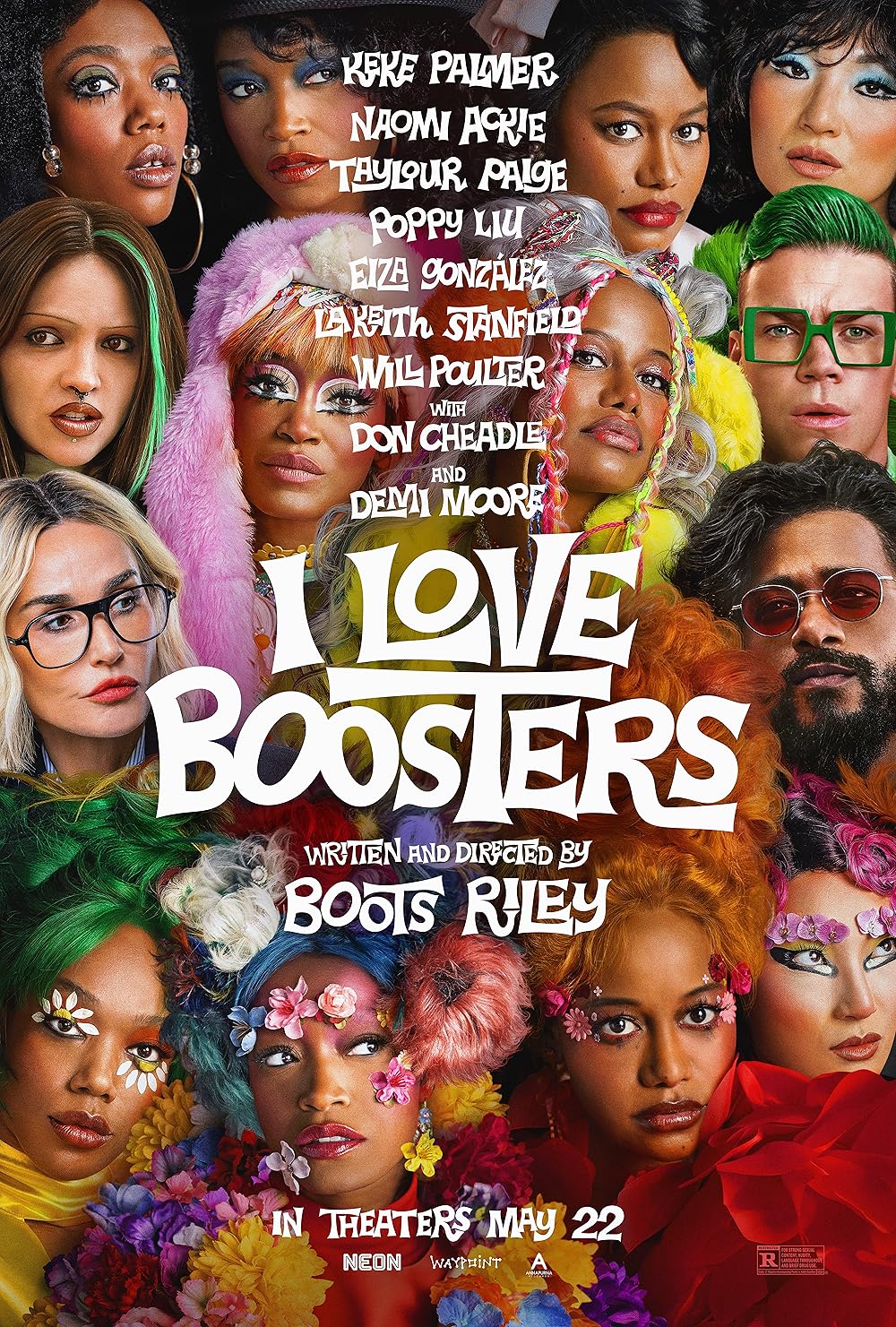
Image Credits: Courtesy of NEON – © NEON Rated via IMDb
Since his debut feature “Sorry to Bother You” sent unexpected shockwaves through the independent scene in 2018, filmmaker-musician-activist Boots Riley has been loved and hated for his unapologetic eccentricity. Fans have embraced the way he casually meshes Marxism with maximalism, while detractors accuse him of loudness, shallowness and aestheticization. Such a ridiculous debate can only merit an even more ridiculous response: enter “I Love Boosters” (2026). Riley’s newest satire is a love letter to the proletariat wrapped in a pop art package. It’s Jean-Luc Godard by way of Dr. Seuss. Riley’s surrealist riot pushes the insanity of late stage capitalism to the extreme; not to shine a light on evils we’re already well acquainted with, but to show us that perhaps the future revolution we all dream of isn’t too out of reach. In a post-screening Q&A at the Philadelphia Film Center, Riley spoke about the politics behind the film, the art that inspired it, and what it took to bring its surreal madness to the big screen.
“I Love Boosters” follows Corvette (Keke Palmer), a booster — someone who shoplifts designer goods then sells them on the street at a discount —- caught between love and loathing for Christie Smith (Demi Moore), the head designer of fast-fashion brand Metro who has declared war on the “low-class urban b****s” stealing from her stores. A chance encounter with a disgruntled factory worker exposes a strange new technology that could bring down Christie for good, leading Corvette on a revenge path filled with time travel, stop-motion skinless shadow organizations, and a literal semen demon.
Riley’s sophomoric feature has a deeply refreshing optimism. Leftist art that wiggles its way into theaters often feels mired by gloom and doom, preferring to wallow in its own helplessness beneath the boot of an unjust system rather than emphasize the people’s power to change that system. It’s clear from the hilarity of its first minutes that wallowing is not something writer-director Boots Riley is interested in. His brightly monochromatic color schemes, optically illusive sets and endlessly creative practical effect usage all work together to create a screwball atmosphere that mocks oppressors and celebrates the oppressed. A who’s-who cast, led by standouts Keke Palmer, Taylour Paige and Naomi Ackie, never needs a breather from the constant barrage of ludicrous comedy Riley channels through them. The Tune-Yards, the Oakland based composers who previously collaborated with Riley on “Sorry to Bother You,” score that cartoonish madness with an oompah-inspired theme that fits the film’s Suessian fever dream feel like an oversized, polka-dotted glove.
Speaking about the booster as a symbol in his film, Riley said, “The media has talked a lot about shoplifting/boosters as the thing that’s breaking down the economy. It’s making an excuse for the downward spiral of capitalism. It doesn’t talk about the other problems in the economy and uses people of color (because that’s not all who do it, but that’s what they show on the news) as a scapegoat for everything that ails folks. […] I’m always thinking about humanity and how the humanity of people is taken away by these explanations of ‘how the world works’, right? And usually it’s the humanity of the working class that’s taken away. And I wanted to talk about folks in that world. That’s what respectability politics are. It’s saying that there is only poverty because people make bad choices. And the reality is that capitalism must have poverty.”
“For those who can’t tell, I’m a communist.” Riley said before being met by thunderous applause from his Philly audience. “I believe we need a world in which the people democratically control the wealth that we create with our labor. I see the attempts at another red scare happening in the media, but I think it’s going the other way. So [the film] kind of shows where things are at, where people are at. I don’t think the red scare is working, but I think what is happening is people are like, ‘How do we do anything, right? How do we change anything?’ It’s been the case to me that most of us are involved in making capitalism work. Most of us think we’re the exception, that we’re just doing it because there’s nothing else we can do. And often, that’s because we haven’t come into contact with a movement that we think can do something, right?”
When asked about how his art applies whimsy to representations of Blackness on screen as opposed to the often trauma-based narratives that dominate Hollywood’s depictions of Black identity, Riley said, “I think that the difference is that I’m not just trying to expose the problems. I’m not just trying to say, ‘Hey, this exists.’ I’m trying to get people involved in class struggle. I think that sometimes people are reacting to this way of painting people that intends to expose trauma, but ends up taking away some of folks’ humanity. And so I think the difference is that my analysis has to do with the fact that we’re in a system that demands a certain poverty, but it’s not just coming from someone’s bad upbringing and terrible situation. It has to do with the whole system. So I think maybe that’s the key that lets me expand on things in our existence that make it feel a little different.”
On his influences for the film, Riley said, “I often will look for inspiration that’s outside of cinema for what I’m doing. So a lot of like collage art, like, you know, Romare Bearded or Parliament Funkadelic, the way there’s a lot of textures and styles put on top of each other. But, then, the cinematic things I think are really just right there in front of [the film] like Jacques Tati, Jerry Lewis, ‘Looney Tunes’. There was somebody on Twitter that said something that I agreed with. They said it’s like ‘Mahogany’ mixed with ‘Willy Wonka’.”
Riley didn’t hesitate to hand much deserved flowers to the film’s stacked cast. “They make it really easy.” He said. “You can have all sorts of visual gags, and you can have a scene where you spend $10 million on the VFX for that scene. And if you don’t buy the person that’s there reacting to it, it doesn’t feel real. If you don’t connect to that character, you don’t care about the $100 million spent on special effects, or whatever. But if you have actors that not only know what they’re doing, but connect to the character, and are able to connect to that moment, then you can have elephants drawing in stick figures coming across the screen and destroying things, and you’d care. The cast bent over backwards to make the movie happen. People moved their schedules around. People called other people on the phone to help me get them in the cast. I think that’s the best special effect I have, this amazing cast.”
“I Love Boosters” can be seen only in theaters May 22.
Elijah Fischer is a fourth-year English major. Contact him at Af997636@wcupa.edu.