

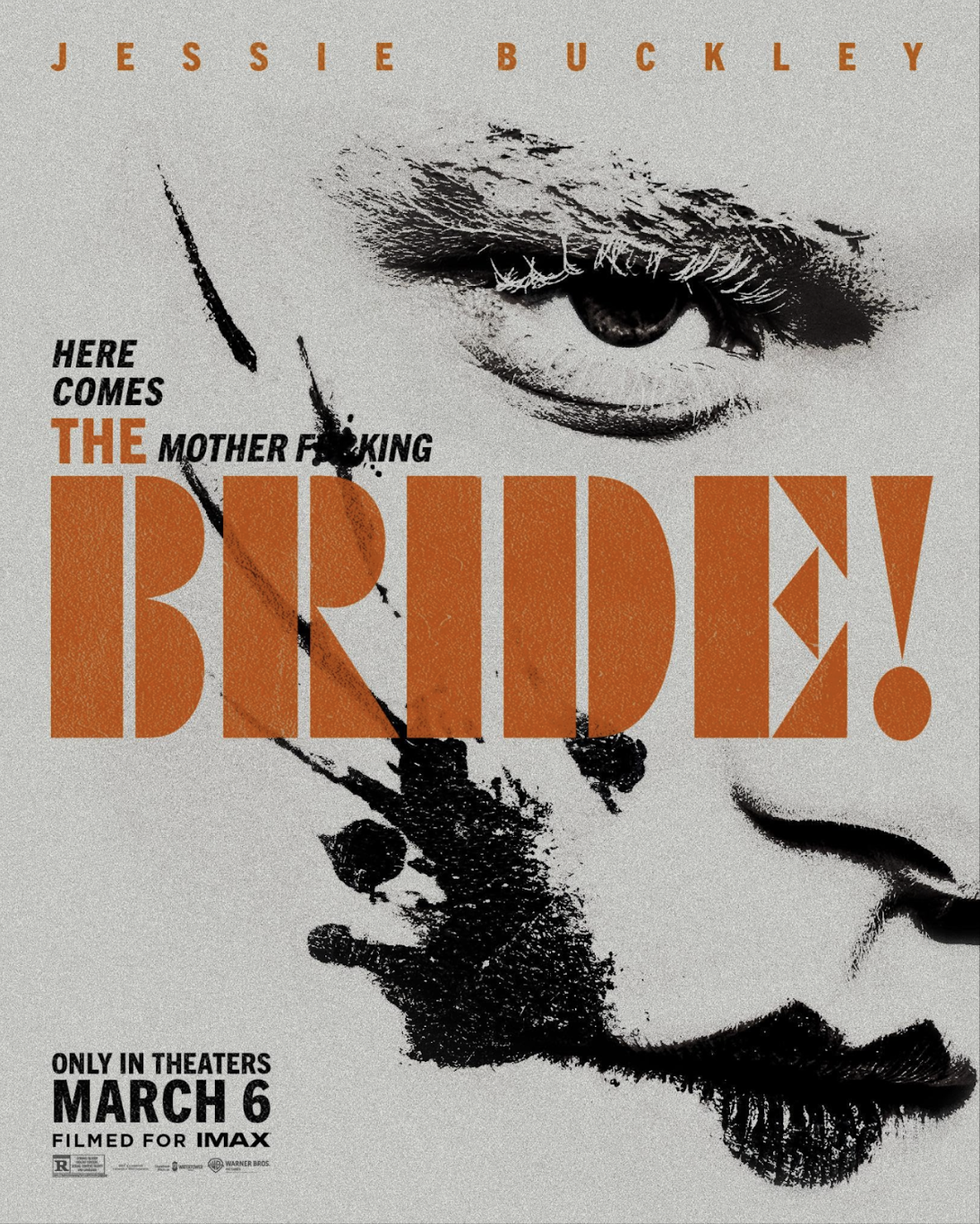
Image Credit: Photo by Courtesy of Warner Bros. Pictures – © Warner Bros. Pictures
God didn’t ask for consent when he took Adam’s rib to create Eve, and Eve didn’t ask for consent to be brought into the world to cure Adam’s loneliness. On paper, this is one of the meatiest problems in the history of storytelling, and what Maggie Gyllenhaal’s new film “The Bride!” (2026) claims to tackle. Applying the tragedy of Eve, a woman who was born into wifehood without ever getting a say of her own, to James Whale’s “Bride of Frankenstein” (1935) sounds like a genius spin on a classic. The trouble is Gyllenhaal’s gonzo ode to individuality doesn’t include that much focus on the “brideness” of its titular character, or on anything else for that matter. It’s impressive how many hats this movie wears, and while that electric confusion definitely creates a once-in-a-lifetime film, it also prevents it from giving its audience anything other than empty calories.
“The Bride!” follows Ida (Jessie Buckley), a woman with mysterious mafia ties in 1930s Chicago. Following a sudden bout of ghostly possession Ida is killed, but promptly resurrected to serve as a companion for Frankenstein (Christian Bale), who in this version of the story is a centuries-old historical figure with a love of movie musicals. Ida embraces the new lease on life she has been given and embarks on an odyssey of crime with Frank(enstein), killing whoever crosses them like an undead Bonnie & Clyde. Their antics spark a “monster revolution,” which draws the ire of both the police and Ida’s former gangster crew, leading the lovers on a cross-country chase that threatens to kill them for good this time.
When “The Bride!” is entertaining, it is undeniably and infectiously entertaining. Maggie Gyllenhaal plays with formalism in a way that’s admirable if nothing else. If she wants to use anachronistic music, or jarring cuts, or throw in a musical sequence, she does it without asking for permission nor forgiveness. Her big swings often pay off in big ways, as some of the most enjoyable parts of the film include Jake Gyllenhaal as a Fred Astaire-esque vaudeville talent turned movie star: Ronnie Reed. Maggie Gyllenhaal recreates the magic of Busby Berkley in beautiful black-and-white, and her brother shines through song and dance, making it even funnier when we see Frank and Ida’s mangled faces begin to replace him and Ginger Rogers in bizarre hallucinations. There’s a painfully lovable earnestness about everything Gyllenhaal does with her film, like a bad high school play. It may be tough to watch, but by God, do those theatre kids give it their all.
However, that contagious breakneck lunacy isn’t sustained for the whole film. Watching Academy Award-winners Jessie Buckley and Christian Bale gnaw on scenery that looks like it’s been sourced from a Hot Topic-sponsored production of The Great Gatsby is a rush, but as the third act closes in we routinely cut away from them to far less interesting characters. The pacing of the film’s conclusion deflates the rebel energy its first half works so hard to create, spending more time on those in Ida’s orbit than Ida herself. It makes the most glaring problem of “The Bride!” rise to the surface: despite being billed as a response to the lack of screentime the character receives in Whale’s “Bride of Frankenstein,” Buckley’s Bride is still having her spotlight stolen by the men in her life. Of course, she wears the pants in her relationship with Frank, but as the film dotes on his cinephilia it only makes you wonder: what are Ida’s interests? What does she like, what does she want, who is she? The film flirts with these questions but ultimately provides no answers: she loves Frankenstein and that’s all that seems to matter. At the end of the day, despite its posturing, The Bride is still not allowed to be more than a bride.
Were it a bit more ideologically sure of itself, “The Bride!” could easily find itself elevated to cult classic status alongside the work of Baz Luhrmann in a few years time. But it struggles to decide if it wants to embrace feminism, queerness and other things that give our conservative status quo the heebie jeebies, or if it just wants to use them to gesture towards a vaguer, more marketable “provocativeness.” Maggie Gyllenhaal’s talent as a filmmaker isn’t up for debate, she is clearly bursting with a unique voice in a time when mainstream cinema is in desperate need of shamelessness; but when all is said and done, “The Bride!” can’t catch up to her direction. Like Dr. Frankenstein (or, in this case, Dr. Cornelia Euphronious), Gyllenhaal has used her mad-scientist vision to stitch together a mixed bag of ideas, images and inspirations to create something one of a kind. One of a kind it may be, but it fails to amount to more than the sum of its parts. The result of her experimentation is a fun but unavoidably flawed film that could use a lot of re-stitching.
Elijah Fischer is a fourth-year English Major with Minors in Journalism and Film Criticism. Contact him at Af997636@wcupa.edu.