

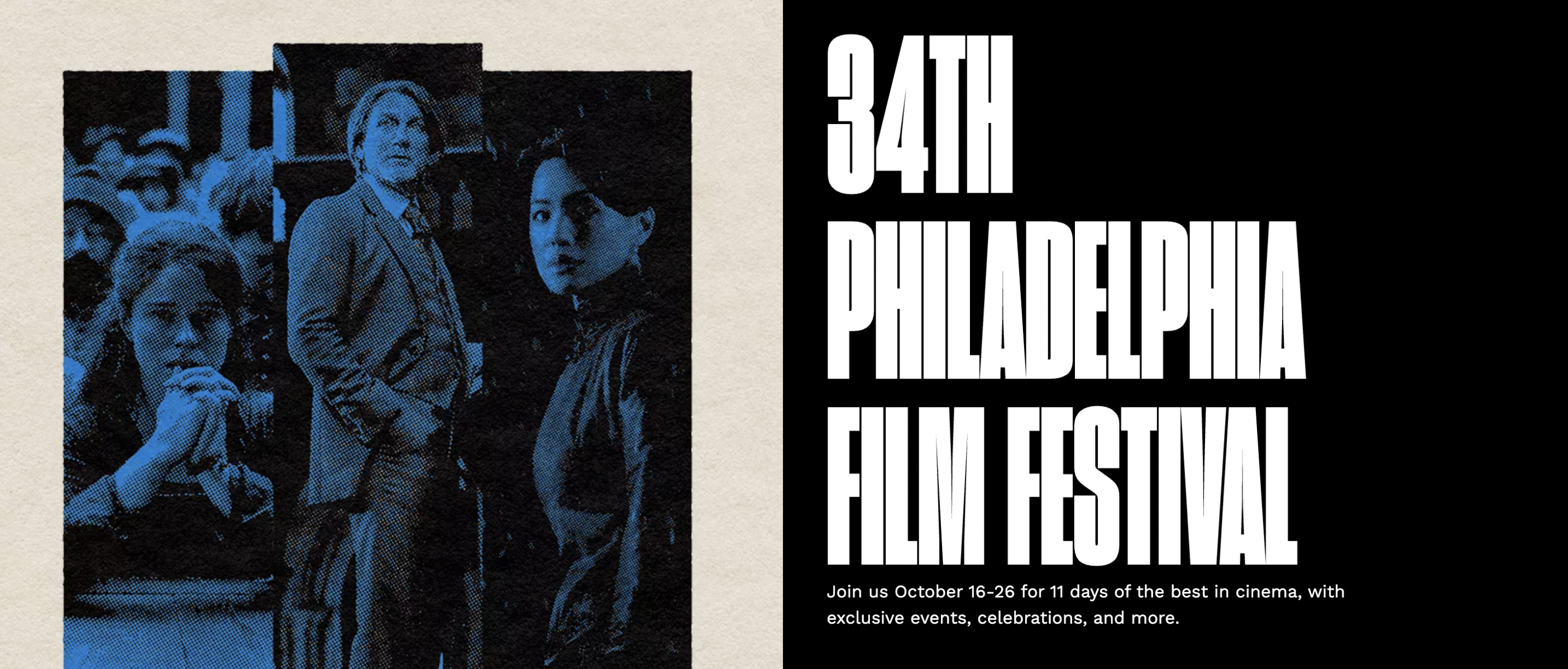
Image Credits: Copyright © 2025 Philadelphia Film Society via https://filmadelphia.org/festival/
The 34th annual Philadelphia Film Festival took place from Oct. 16 to Oct. 26, offering 11 days of films from every corner of the world and notable artists such as Guilermo Del Toro, Joachim Trier, Bi Gan and Kelly Reichardt. The lineup this year held two common themes: grief and revolution, and with the two spilling into each other, the festivalgoers were left with quite a bit to mull over. Among the best of the festival were Stillz’ surreal directorial debut “Barrio Triste,” local Philly indie “Alice-Heart,” and the expansive historical epic “Magellan.” With so few major film festivals offered in Pennsylvania at all, it’s a small miracle that every year the Philadelphia Film Society and its amazing team of programmers and volunteers offer an oasis to the local cinephile. I saw 21 films in total this year (which among many festivalgoers is still considered rookie numbers), each of which has been broken down in the article below.
“Wake Up Dead Man: A Knives Out Mystery” Dir. Rian Johnson
Opening Night of the festival kicked off with the Philadelphia premiere of “Wake Up Dead Man,” the third installment of Rian Johnson’s murdery-mystery franchise “Knives Out.” Johnson’s semi-gothic threequel follows Father Jud Duplenticy (Josh O’Connor), a young priest with a checkered past who is sent to an isolated church in upstate New York to assist Monsignor Jefferson Wicks (Josh Brolin) in leading his cult-like congregation. When a murder occurs at the church, Benoit Blanc (Daniel Craig) is called upon to help solve the case, leading to a battle of faiths that threatens to uncover the sordid secrets of every churchgoer.
As expected, “Wake Up Dead Man” is led by a star-studded ensemble cast featuring icons of the screen and stage such as Glenn Close, Andrew Scott and Kerry Washington. O’Connor stands out as the guiding light however, delivering a sensitive and complicated performance that’s refreshingly tender in a series known for its scenery-chewing. Johnson’s direction takes full advantage of its religious themes and setting to interject some horror into his usual formula, and it pays off in spades. The eerie set design and spacious cinematography almost put his audience in the shoes of a lingering ghost, playing perfectly into the “Knives Out” motif of dark family secrets that don’t stay buried for long.
The festival had the pleasure of being joined in person by writer-director Rian Johnson for a Q&A, at which he elaborated a bit on the tonal shift from its predecessor, “Glass Onion.”
“I really wanted to ground the next one,” Johnson said. “I wanted to make it about faith because that’s something very very personal to me, so I thought that would challenge me. I didn’t grow up Catholic, I grew up very Christian though. I had a very personal faith and I really framed the whole world through my relationship with Christ, and I’m not a believer anymore. I kind of drifted away from that in my 20’s, but as anyone who has had that will tell you it never really leaves you. So the idea of ‘can we get these [themes] into one of these movies and still have it be a fun murder-mystery was something that seemed like an interesting challenge.” While it has fun in spades, “Wake Up Dead Man” is far more complex than its predecessors and Johnson proves he has far more to say with his franchise than simple wealth satire.
“Hysteria” Dir. Mehmet Akif Büyükatalay
“Hysteria” is a thriller from German writer-director Mehmet Akif Büyükatalay, who is also of Turkish background. It follows Elif (Devrim Lingnau), a production intern on a film dramatizing the 1993 Solingen arson attack, in which Neo-Nazis set fire to the home of Turkish immigrants, resulting in the deaths of five people (including a four-year-old girl). When a real Quran is found burned on the set of the film by refugees enlisted as extras, it sparks a controversy that finds Elif caught between the refugees and her bosses, all as she is stalked by a mysterious figure she suspects may be involved in the chaos.
Büyükatalay is a skilled enough director, drawing palpably real performances from his cast and shooting shadowed doorways and lingering gazes with a wonderfully chilly tension. However, his script leaves much to be desired. Consequences are kept at arms length throughout the film, unable to be felt until its explosive finale that feels like an unearned way to tie up directionless subplots. Its runtime also meanders, frequently cutting to black at emotionally conclusive moments only to drag out the conflict longer than necessary until we’re too bored to care who’s really behind it all. While its setbacks keep this thriller from being truly thrilling, Büyükatalay shows immense promise as a filmmaker, though hopefully his future projects showcase his visual talents more so than his screenwriting.
“Hamnet” Dir. Chloe Zhao
There is little praise left to give Chloe Zhao’s “Hamnet” that has not already been earned. From Jessie Buckley’s gut-wrenching performance as a grieving mother, to how Paul Mescal brings a human fragility to the larger-than-life legacy of William Shakespeare, to Zhao’s breathtakingly moving cinematography that makes every gust of wind through the branches feel like weight on the heart of the viewer, the lauding has been coming in a well-deserved shower. “Hamnet” is about Agnes Shakespeare (Buckley), a woman struggling with the death of her child in a community that does not accept her. All the while, her husband William (Paul Mescal) is growing increasingly more distant and absent as he begins to form what will eventually become the Tragedy of Hamlet. As grief threatens their relationship, the couple must learn to understand one another’s pain as their shared sandboxes of nature and art become their joint venture for closure.
Zhao turns the camera into a lightning rod for empathy in an unprecedented way. Like transcendentalist Terrence Malick, she makes nature a grounding point to tether the outsider to, a tool through which they can express themselves in unashamed totality. Through Zhao’s vision, Irish author Maggie O’Farrell’s source novel is translated into an indictment of English colonialism’s ripple effects, making the subject of loss one that is soaked into the Earth for all of us to feel rather than simply a personal journey for the Shakespeare family to go through alone. The end result is a film that is as universal as it is intimate, as powerful as it is gentle and as timeless as it is haunted.
“Blue Moon” Dir. Richard Linklater
“Blue Moon” invites its audience to spend a night with Lorenz Hart (Ethan Hawke), a once-great lyricist left behind by time as he gets drunk in a New York City cocktail lounge following the premiere of “Oklahoma!,” his former collaborator Richard Rogers (Andrew Scott)’s first success as part of the musical duo that would become Rodgers & Hammerstein. While Hart comes to terms with the beginning of his end, he fights for the affections of Elizabeth (Margaret Qualley), a college student he has taken to mentoring as she attempts to claw her way into the New York social scene. Familiar faces come and go as Hart talks the ear off his salt-of-the-earth bartender (Bobby Cannavale) and ponders love, loss and where to go next (if there’s anywhere to go at all).
Veteran filmmaker Richard Linklater has never been one to follow trends. So it only makes sense that in an era dominated by superhero slop he would decide to produce a dialogue-heavy, single-location period piece about a 20th century titan of Americana who has mostly been lost to time. It’s remarkable how jazzy and fast-paced the film is, despite its contained location and ceaseless conversation. Linklater’s masterful direction and Robert Kaplow’s witty script converge with Hawke’s electric performance to create a quiet miracle on screen. Obvious as it may be that the film is a thematic warm-up to Linklater’s highly anticipated “Merrily We Roll Along” adaptation, the film also stands on its own as a mercifully adult tragicomedy about the myth of the artist in American folklore and the inevitable regrets it comes with.
“The Mastermind” Dir. Kelly Reichardt
As another veteran filmmaker known for balking trends, and one of the greatest artists of modern American canon, Kelly Reichardt almost needs no introduction. Her calculatedly slow, earth-toned portraits of human life amidst the emptiest and loneliest valleys and highways of the United States always pack a punch. “The Mastermind” is no different, proving that in a world where cinema rarely takes time to breathe anymore, what we need most are stories that allow themselves to be felt.
“The Mastermind” stars Josh O’Connor as J.B. Mooney, a failed art-school student who plans to change his dull life and provide for his wife (played by the always welcome Alana Haim) and kids by stealing four priceless paintings from a local art museum. When the heist goes wrong, J.B. is left the unlucky odd-man-out and ends up stuck on the run across smalltown America, running into familiar faces from his past as his future slips further and further out of control.
Reichardt’s portraits of the American Dream as a bad-luck curse have more poignance today than ever before, and that shines especially through “The Mastermind.” The way J.B.’s struggles, made raw and felt deeply due to O’Connor’s humanistic performance, are contrasted with the struggles of Vietnam-era America, and even how those struggles are contrasted with America’s society today in which so little has changed, is nothing short of genius. It is not easy to make art as precise and quietly powerful as Reichardt’s films, but thankfully she has never sacrificed what makes her stories so moving in order to appease audiences that resist having to sit with the frame.
“Alice-Heart” Dir. Mike Macera
Mumblecore is finding its renaissance through the scrappy beauty of Philadelphia, and nowhere is that scrappy beauty more on-display than in “Alice-Heart.” With a cast and crew consisting mostly of recent Temple University graduates, it’s hard to not feel what a labor of love this film was through each moment of runtime. What’s more impressive than the love put into it, though, is the genuine strength of its end product. “Alice-Heart” is not great for Philadelphia, or great for a project with such young creatives behind it, it’s just a great film without any caveats needed. That is where its impressiveness lies.
“Alice-Heart” stars Lissa Carandang-Sweeney in its titular role as Drexel student Alice Heart. After being dumped by her boyfriend (Adam McAlonie), losing her apartment and dropping out of school, Alice has officially hit rock bottom. Things turn around, however, when a friendship with her neighbor, Tony (Tony McCall) forces her to evaluate what she really wants out of her life, and more importantly, out of the people she decides to spend it with.
Macera’s direction and “Frances Ha” inspired black-and-white cinematography turns a city that is usually seen as the ugly stepsister to New York City into one that can rival its beauty. When you think of how to describe the Schuylkill River, a million words may come into your head, none of them being “picturesque.” Macera seizes that ugliness, that scrappiness, that misfit attitude and interjects it into every frame of his film, every word of his script. It results in something that fits the Mumblecore mold better than Brooklyn could ever dream of. Carandang-Sweeney, McCall and McAlonie are all hilarious as lost souls caught between adolescence and adulthood and still unsure which side of the line they want to land on. The dynamic and chemistry between Carandang-Sweeney and McCall in particular is wonderful to witness, as for once a female protagonist is allowed to be the work-in-progress while her pretty male counterpart takes the role of “Manic Pixie Dream Boy.” It’s clear when watching “Alice-Heart” that the future of art in Philadelphia is in good hands, ones not willing to sacrifice the deviance and grunge that make this city great even when dipping those hands into a subgenre that traditionally hasn’t belonged to them.
“Nouvelle Vague” Dir. Richard Linklater
The second Linklater of the festival, another mid-century period piece reflecting on the nature of the artist, is unfortunately the lesser one. “Nouvelle Vague” stars Guillaume Marbeck as Jean-Luc Godard, Zoey Deutch as Jean Seberg and Aubry Dullin as Jean-Paul Belmondo while it retells the tumultuous making of “Breathless” (1960), which would come to define the French New Wave cinematic movement. We watch as Godard fights to make an untraditional film on his own terms, which include wasting entire days of an already stretched-thin production, shooting without a script, and interjecting quotes from his favorite Hollywood films without rhyme or reason. Though the end result may be something that changes film forever, the chaos leading up to it leaves Godard’s cast, crew and producers all asking the same thing: is it really worth it?
Like with Godard’s production style, “Nouvelle Vague” is unfortunately aimless in a way its companion piece “Blue Moon” is not. We are shown quite a few familiar faces from Cahiers Du Cinema, but they amount to little more than cameos for cinephiles in the audience to get a kick out of rather than contributing to the narrative. The narrative itself has little to offer, being based around the making of a film that so boldly speaks for itself and contributing nothing to what it has already said. Marbeck, Deutch and Dullin are all decently funny, particularly Marbeck in highlighting how unlikable Godard truly was, but all of these performers are trapped by no fault of their own in the shadows of giants. It all leads to a film that is decent, but unfortunately too empty to be of note, especially next to the eclipsing “Blue Moon.”
“No Other Choice” Dir. Park Chan-wook
AI is an existential threat intrinsic to the evils of late-stage capitalism. So it’s unsurprising that legend of South Korean cinema Park Chan-wook would decide to tackle the automation epidemic with his newest feature, “No Other Choice.” The film follows Man-su (Lee Byung-hun), a family man who is fired from his job of 25 years and must re-enter a job market that no longer values human experience. To get a leg up against his younger competitors, Man-su decides to take a deadly approach to ensuring he’s the prime candidate for the job.
Park Chan-wook’s film is as visually stunning as it is darkly funny. With rich color schemes, elaborately choreographed camera movement and his trademark cross dissolves, “No Other Choice” is itself a testament to the power of human art in a world where humanity is beginning to matter less and less. Byung-hun’s performance taps into that dehumanization with shocking range, as he is able to go from hilarious to frightening to tragic at a moment’s notice. “No Other Choice,” like Chan-wook’s other works, is a bloody cinematic fable, only this time the horror is not hidden in the nightmares of the past, but in our bleakly inhuman future under late-stage capitalism.
“If I Had Legs I’d Kick You” Dir. Mary Bronstein
“If I Had Legs I’d Kick You” channels the horror of motherhood into an experience which, for better and for worse, is utterly alien. The film follows Linda (Rose Bryne), a therapist with an absent husband, who is left to care for their incredibly sick daughter all on her own. When the ceiling of their apartment collapses due to a burst pipe, Linda and her daughter move into a hotel, where Linda’s increasingly slipping psyche is consumed by the hole in the apartment’s ceiling and what connections it may have to the one in her daughter’s stomach.
Mary Bronstein’s direction is incredibly hands-on. Most of the film is shot in incredibly tight medium shots centered on Linda, shutting out the world around her beyond the constant yelling of her daughter and the chastising from everyone she meets on her insufficient mothering. Unfortunately, the claustrophobia successfully achieved by the film dampens its impact, as it makes its story so interior that we are left with nothing but Linda’s struggle to hold on to. Further, the film aims for surreality but never fully commits, cutting away as soon as things get too strange or refusing to build on what strangeness it does settle on as it would take the focus away from Linda and her troubles. Though interiority can be a strength when it comes to horror, here the frame and story are so suffocating that it leaves everything rolling off your back. Motherhood is nightmarish, but in “If I Had Legs I’d Kick You” that nightmare is unfortunately too contained to feel tangible.
“Frankenstein” Dir. Guillermo Del Toro
Romance feels like a lost art in streaming-era Hollywood, but Guillermo Del Toro is one of the few “vulgar auteurists” left carrying its torch. It’s romance that works as the guiding light for his sprawlingly gothic adaptation of “Frankenstein.” The film stars Oscar Isaac as Victor Frankenstein, a mad scientist who, in a selfish quest to play God, reanimates a creature (Jacob Elordi) constructed from the mismatched body parts of cadavers. When the creature escapes, a globe-spanning chase ensues that will reveal once and for all who the real monster is.
Del Toro’s vision is a deeply textured take on the familiarly horrifying classic. Despite a cast featuring unspeakably talented performers such as Mia Goth, Christoph Waltz and Charles Dance, the true stars of “Frankenstein” are Tamara Deverell’s production design and Kate Hawley’s costuming. Every single frame intoxicates you with its atmosphere, drowning the viewer in a fairy tale nightmare that borders on biblical. Though it suffers slightly from the infamous Netflix lighting and camera requirements, Del Toro makes the absolute most of its streaming destination by filling each image to the brink. Composer Alexandre Desplat (who previously worked with Del Toro to deliver the Academy Award-winning score for his last romantic monster movie (“The Shape of Water”) cloaks the film in an orchestral soundtrack that sinks you further into the gothic embrace of a Del Toro fairy tale. “Frankenstein” is not a modern take on a familiar story, but instead a welcome relic of a time when magic mattered more to audiences and studios alike.
“Jay Kelly” Dir. Noah Baumbach
Another Netflix entry about legacy and its consequences, “Jay Kelly” stars George Clooney in its semi-meta titular role, and unfortunately that’s where the movie’s faults begin. Jay Kelly (Clooney) is one of the last movie stars, an iconic relic of a time before streaming. However, when a producer and longtime friend dies, Kelly is made to re-evaluate his past and the many mistakes he has made on the road to stardom, all while leading up to the acceptance of a lifetime achievement award at an unnamed film festival in Italy. Flanked by sycophants (Adam Sandler and Laura Dern) who are growing increasingly resentful of the amount of their lives they’ve thrown away on him, Kelly slowly begins to unravel as he realizes that his legacy may not be everything he’s built it up to be.
Baumbach obviously takes inspiration from films like “8 ½” (1963), attempting to merge surrealism with semi-meta commentary on the circus of the entertainment industry. Unfortunately it leans too heavily into the presence of Clooney, and at a certain point the amount of winking to the audience becomes groan-worthy rather than funny or interesting. Baumbach is too restrained and intimate of a director, and Clooney too cardboard of an actor, for a Fellini-esque attempt like this to stick its landing.
“The Love That Remains” Dir. Hlynur Pálmason
Fresh off the critical success of “Godland” (2022), Hlynur Pálmason’s “The Love That Remains” is a pastel-colored surrealist family drama about a couple navigating divorce. Anna (Saga Garðarsdóttir) and Magnus (Sverrir Guðnason) are young parents who are torn apart by circumstance and must learn how to remain a family even as they begin to officially separate. Pálmason’s stunning portrait of change amidst the backdrop of rural Sweden is beautiful and painterly, managing to tell a universal story in a unique and uncompromised way. At times funny, at other times sad and even bordering on dreamlike at its best and worst moments, “The Love That Remains” is a film that more than earns its gaze.
“The Voice of Hind Rajab” Dir. Kaouther Ben Hania
As we enter the third year of the genocide in Palestine, the naivety brought in the wake of Academy Award-winner “No Other Land” has worn off. As the filmmakers behind “No Other Land” are lynched, terrorized and attacked by Israeli Occupation Forces without consequence, the belief that documentation is enough to incite change has unfortunately worn off. What has become clear, however, is documentation’s role in indictment. “The Voice of Hind Rajab” does not inspire, instead it damns a world that goes on spinning in the face of atrocity. To bear witness is a radical act, not because it may change a heart and mind that is already too rotten to be saved, but because it prevents those rotten hearts and minds from hiding beneath the excuse of ignorance.
“The Voice of Hind Rajab” is a dramatization of the hours spent by Red Crescent emergency services trying to save the life of Hind Rajab, a six-year-old girl trapped in a car after Israeli forces fired on civilians fleeing Gaza City. Surrounded by the corpses of her family, Hind remained on the phone with volunteers at the Red Crescent for hours as attempts by emergency services to rescue her were routinely thwarted by murderous Israeli Occupation Forces. As the film attempts to recreate those hours, every word we hear spoken by Hind is her real voice, and Ben Hania intercuts real footage of the family of Hind as well as volunteers at the Red Crescent, blurring the lines of reality and dramatization to make a powerful statement on how art bears witness to guilt even when the rest of the world feigns ignorance.
“Resurrection” Dir. Bi Gan
Throughout history, film has functioned as both an antidote to and a tool of fascism. But Bi Gan’s dreamy, era-jumping epic proves that disruption is what separates fascist and antifascist cinema, and how powerful of a tool disruption can be in allowing unrestrained imagination to flourish.
“Ressurection” is set in a world that has discovered the secret to eternal life: the end of dreams. To outlaw dreaming, a fascist status quo distributes drugs that prevent the populace from using its imagination, hunting down those who are capable of dreaming and executing them. However, one dreamer has escaped, and is hiding within the media of film itself, leading to a never-ending rabbit hole of cinematic stories that unfolds throughout the film as the dreamer is chased through each one. Bi Gan taps into the full force of expressionism, maximalism and transcendentalism to toss his audience through the looking glass and over the rainbow. Just as one story reaches its end, the camera shifts to another, and it becomes impossible to find your way out of the escapism in a beautifully disorienting way. The best films are ones that defy any attempt at description, films that must be seen and heard and felt to be believed. “Resurrection” can not be translated into words: in pure cinematic fashion, it’s a dream you must dive into yourself.
“Train Dreams” Dir. Clint Bentley
Netflix’s attempt at recapturing the awe-inspiration of 2024’s “The Brutalist” pales in comparison, though its cozy pine-smelling scenes of 20th century change aren’t without their pluses. “Train Dreams” follows Robert Granier (Joel Edgerton), a railway worker at the turn of the century, who begins to ponder his purpose as his wife (Felicity Jones) and child call him away more and more from the everchanging landscape of the West. While Bentley shoots the forests, hills and plains of early-20th century America with the crisp beauty its breathtaking expanse deserves, the bones of the story laid by Denis Johnson’s novella leave much to be desired. “Train Dreams” sits inescapably in the shadow of “The Brutalist,” only made more apparent by the inclusion of the amazing Felicity Jones, who is wasted here as she is given nothing to do other than be a wife and mother. Outdated characters, attempts at addressing the horrors of Americana that fizzle out into nothingness and a pervasive shallowness kept “Train Dreams” from hitting the mark it often gets close to, but can never manage to properly strike.
“Nuestra Tierra” Dir. Lucrecia Martel
Lucrecia Martel is one of Latin America’s most respected auteurs, best known for her narrative works that highlight class and wealth gaps within Argentine society through the eyes of strong female protagonists. “Nuestra Tierra”, or “Landmarks” in English, marks her first foray into documentary, and despite the shift in narrative format, her storytelling has not lost its power or ability to hold the highest ranking and most insidious of Argentina’s elite accountable.
“Nuestra Tierra” focuses on the murder of Javier Chocobar, leader of the indigenous Chuschagasta community in rural Argentina, by a wealthy landowner and two former police officers. Through the documentation of their trial and the history of Chuschagasta land, Martel exposes a long and sordid history of colonial oppression in Argentina, and the modern results of historical injustices that pervade to this day. Martel’s use of gorgeous aerial cinematography, which literally puts the viewer in the position of God observing these lands and the injustices taking place upon them, a powerful statement is made about how history is not as alien as we think: the injustice of the past becomes the injustice of the present if the powerful allow it.
“Barrio Triste” Dir. Stillz
Produced by Harmony Korine and scored operatically by Arca, “Barrio Triste” is punk to the core and unashamed of it. Set in 1980’s Colombia, the film is a found-footage odyssey through the streets of Medellín after a group of delinquent boys steal a news camera to document their days and nights, which are marked by aliens, serial killers and the fires of hell itself. Stillz is best known for his musical collaborations, filming with artists such as Rosalía and Bad Bunny, but it’s remarkable to hear that “Barrio Triste” is his first attempt at narrative filmmaking. The sickly stunning creativity he showcases, attempting to spark class consciousness via acid-trip, is reminiscent of Korine’s trailblazing work with “Gummo” (1997). Punk is a term that gets thrown around often, misappropriated and commercialized until it has lost its meaning, but as we spend time on the rooftops of a Latin American ghetto, watching the lives of those pushed to the bottom unfold before us, we’re reminded that punkness will always be gross and unsettling and magically strange. Through the grainy VHS footage that treats each piece of trash in the street, each vulgar message of graffiti sprayed across the wall, and each urine-soaked alleyway as a thing of perverted beauty, we’re reminded of what put filmmakers like Korine on the map: an understanding that great art will always be unashamedly punk.
“Magellan” Dir. Lav Diaz
No one has a better understanding of the ridiculous evil of the colonizer better than the colonized. Filipino auteur Lav Diaz is not known for being concise, but he is known for having a lot to say, and though it’s easily his most mainstream venture yet “Magellan” is no exception.
“Magellan” stars Gael Garcia Bernal as conquistador Ferdinand Magellan, as he attempts to colonize the Philippines despite the protests of his crew, his king and the natives. While Magellan is given a bit of complexity, what we see of him through Diaz’s eyes is a look at the great colonizers of history we rarely get to see: an idiotic, monstrous, bloodthirsty oaf. Bernal embodies the role with an unsettling coldness that is rare to see from him, but showcases his dramatic range. Armado Arjay Babon delivers the most masterful performance of the film, however, vulnerable and complex as Enrique de Malaca, slave of Magellan, who is caught between the colonizers and the colonized. Diaz’s painterly shots give each frame the gravitas and expanse its history demands, giving skilled performers like Babon ample time to feel at home in each shot. The joint efforts of cast and crew pay off in spades to create a unique telling of history from the point of view of those least often allowed to use their voices.
“Dead Man’s Wire” Dir. Gus Van Sant
In the wake of Luigi Mangione’s alleged assassination of insurance magnate Brian Thompson, America is having to come to terms with the power of the people. Gus Van Sant’s “Dead Man’s Wire” is a reminder that class struggle is an American war that has always been fought and is far from being over, but as media becomes increasingly widespread, that war will become harder and harder to hide. Starring Bill Skarsgard, Dacre Montgomery and Philly native Colman Domingo, the film recounts the 1977 kidnapping of mortgage broker Richard Hall by Tony Kiritsis, accomplished via a device known as the “dead man’s wire” which connected both Hall and Kiritsis to a shotgun rigged to blow Hall’s head off should either of them be separated. The film documents the media circus, the indifference of both Hall and Kiritsis to the pain they caused one another and the eventual trial that resulted in Kiritsis being declared innocent despite the highly publicized kidnapping.
Van Sant’s film is one that ties the aesthetics and cultural moments of the 1970s to the violence of today, not only through decisive directorial decisions, but through the timelessness of its real life story. Colman Domingo’s swanky radio host Fred Heckman, who acts as the grounding point amidst the chaos Kiritsis creates, could easily be any popular podcaster or youtuber. Van Sant’s quintessentially slow zooms, freeze frames and grained footage are the only reminders that what we’re watching unfold isn’t present day. The film’s tagline plays into its closing credits use of “The Revolution Will Not Be Televised” by Gil Scott-Heron, which when combined with Van Sant’s objective view of Kiritsis’ actions, practically screams at the viewer that this film will be the first entry in what is sure to be a long line of “Luigi-core” films examining the inevitability of violent revolution against an unchanging, and uncaring, status quo.
“Is This Thing On?” Dir. Bradley Cooper
Bradley Cooper’s follow up to his first two Oscar-nominated directorial efforts is unfortunately lukewarm at best. Starring Will Arnett and Laura Dern as a finance-man-turned-standup-comic and a former-olympian-turned-housewife, Cooper attempts to find humor in the messiness of divorce and midlife crises. However, there is no depth, meat or tragedy in the midst of all that mess. It’s admirable of Cooper to try and attempt a realistic approach to divorce rather than the overdramatic breaking of dishes and punching of walls, but in the absence of those dramatics there’s nothing for us to get attached to. Arnett’s standup is unfortunately unfunny, verging on trauma dumping and firing out stale jokes that would’ve seemed like tired bits in the early-2000’s. Dern, one of our greatest living actresses, is given almost nothing to do in the film while Cooper cameos as a character who, right before his first appearance, is explicitly defined as great at sex by another character. These decisions, along with the amateur camerawork also done by Cooper, leave a perilously undercooked taste in the mouth. Its biggest crime is its use of Queen’s “Under Pressure” at a pivotal moment, reminding the audience that a far better parent-navigating-divorce story (Charlotte Wells’ “Aftersun”) came out only three years prior.
“Sentimental Value” dir. Joachim Trier
The closing film of the Philadelphia Film Festival was another exercise in familial trauma, this time as framed through the unknowable traumas locked in the walls of the family home. “Sentimental Value” follows “Nora” (Renate Reinsve), a stage actress who is forced to reconnect with her estranged father Gustav (Stellan Skarsgard) after the death of her mother. Gustav, a prolific film director, has decided to make an autobiographical film processing the trauma of himself, his children and his mother in order to get some form of closure, casting famous Hollywood darling Rachel Kemp (Elle Fanning) as the composite of his daughters.
Trier’s admirably ambitious script unfortunately loses focus, finding so much to chew on that it often forgets to bite down on things deserving of more attention. Skarsgard and Reinsve have such beautifully chilly chemistry, but as the story meanders we don’t get to see them act on their tensions of trauma left unspoken enough, leaving the audience as desperate for closure as its characters. Visually, the film does not lean into its own surreality enough, trying to interject it at moments and tie back to the visual metaphor of the family’s crumbling house only to again lose focus and meander. The meandering makes for a good film, but it’s frustrating when you know a great one is lurking just beneath its foundation.
The Philadelphia Film Festival continues to be a lighthouse for the Pennsylvanian cinephile, a much needed one in state unfairly overlooked in terms of film despite our many claims to fame. It’s a comfort to know that, if all else fails, each October will bring one of the most accessible, affordable and diverse film festivals this side of the Delaware.
Elijah Fischer is a fourth-year English and MDC major. AF997636@wcupa.edu.