

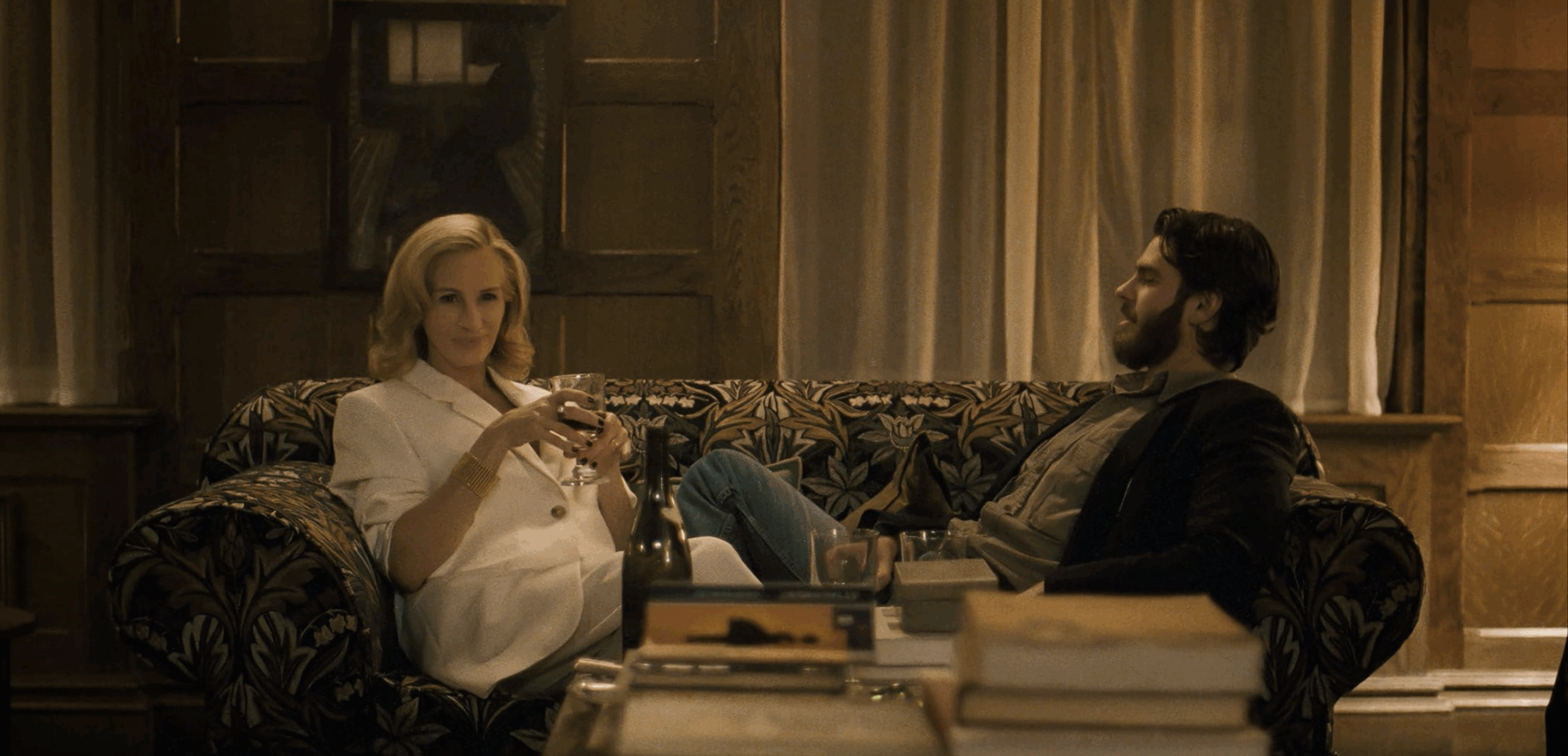
Image Credits: Photo by Courtesy of Amazon MGM Studios/Courtesy of Amazon MGM Studios – © 2025 Amazon Content Services LLC
“Not everything is supposed to make you comfortable.”
The stand out quote from director Luca Guadagnino’s latest film, “After the Hunt,” (2025) shows ethos and intent, truly not allowing the audience a moment of comfort. Showcased at the 63rd annual New York Film Festival in the Lincoln Center, The Quad was invited by Amazon-MGM Studios to see the North American premiere of “After the Hunt” on opening night. In a once-in-a-lifetime opportunity for The Quad reporters, Alice Tully Hall rolled out its black carpet for stars Julia Roberts, Ayo Edibiri, Andrew Garfield and Michael Stulberg as well as prolific director Luca Guadagnino and debut screenwriter, Nora Garrett. The cast and director shared some words with us in an in-person introduction before the film, making the message clear: “After The Hunt” wants to spark conversation.
The film follows Yale professor Alma Imhoff (Julia Roberts) as she navigates a cultural minefield after her close colleague Hank Gibson (Andrew Garfield) is accused of sexual misconduct by shared student Maggie Price (Ayo Edibiri). However, when Alma begins to dig deeper, what seems like a clear-cut case of abuse becomes a mystery of hidden agendas, one that Alma must solve before she loses her life’s work. In an introduction before the screening, Julia Roberts made the intention of divisiveness and dialogue clear. “When this is over,” she said ominously, “talk to each other”.
“After The Hunt” features a star-studded cast who bring a much needed complexity to an incredibly complex story. Roberts, Garfield and Edibiri dominate the screen with a presence that demands your attention. Garfield’s booming voice and quick-witted, aggressive tone cause every scene he’s in to shake you to your core, leaving the audience nervous every time we’re alone with him. Edibri, on the other hand, is much more subtle, asserting her dominance over the narrative through body language. She doesn’t allow the audience to fully know her character, but still allows them to feel her. Stuhlburg’s performance, on the other hand, is a fantastic blend of wit and comedic relief with a silent tragedy lurking underneath the laughter. From beginning to end, the visceral reality beneath the film’s subject matter is brought to life through the tangibly raw performances of its talented cast.
Guadagnino had a very distinct vision for this film, one that cinematographer Malik Hassan Sayeed channels through every intense shot. Guadagnino and Sayeed work as one, knowing exactly when to let the camera eavesdrop and when to shove it in your face. Framing that violates convention as well as personal space gives the feeling that you’re in the room alongside these characters, unable to look away. A score by returning Guadagnino collaborators Trent Reznor and Atticus Ross makes the discomfort “After the Hunt” aims for twice as gnawing.
Best known as the post-punk icons behind Nine Inch Nails and more recently for their work on film scores such as “The Social Network” (2010) and “Tron: Ares” (2025), Reznor and Ross’ orchestration is brilliant and terrifying. It perfectly echoes the instability “After the Hunt” taps into, holding its breath in one moment only so it can scream into the darkness in another. Reznor and Ross leave each note burdened with the weight of the characters actions, sinking under the skin to the tune of a discordant saxophone.
The score uses this different approach more than one would expect, however, as it echoes both interpersonal and internal states. For example, Frederick – Alma’s husband – is frequently shown enjoying music booming from his stereo. Listening to beautiful classical compositions allows him to feel a sense of contentment while also drowning out the problems he and Alma face in married life. Conversely, Alma is haunted by moments of silence followed by the horrifically jagged and dissonant score which further highlights how separate they are. “After the Hunt” seems more interested in using music genre and style as a way of dividing and signaling the emotional states of its characters, rather than a more traditional motif system.
Thematically, the film draws heavily from the cultural zeitgeist of “#MeToo,” complete with a ticking clock motif to hammer home that Time is Up. However, in the near decade since the #MeToo movement shined a light on these uncomfortable topics, it feels like the conversation the film is hoping to have might be a bit late to the game. In hopes of simply facilitating a conversation rather than taking a stance within it, the film ends up not having much to add in the way of meaningful social commentary. In a society that has already achieved a baby-step within the conversation, one is left to worry if neutrality is even a feasible option anymore when dealing with such sensitive topics.
This failure to consider the implications this narrative might have for victims is disappointing. If only the film had focused more on the moral obligation of people to support victims in need, then this film could have had a lot more to say and positively add to the conversation, while still maintaining its distinct style and execution. Unfortunately, we are left with a film that opens a space for victims to be denied justice, disbelief to be sown with a sense of righteousness and for those potential supporters to not feel how essential it is that they do the right thing.
The Quad’s Assistant Arts & Entertainment Editor, Elijah Fischer, got the opportunity to speak with the director, screenwriter and cast in a press conference held for student journalists. When asked why they chose Yale specifically as the setting for this story, Guadagnino and Garrett emphasized its gothic atmosphere. “The gothic architecture was something I felt was very evocative,” Garret said, “because it’s both oppressive and lofty simultaneously.” Guadagnino added on the looming presence of legacy, “I think the contained space [Yale’s campus, as well as the surrounding working-class town of New Haven] had great cinematic qualities. There is a tradition of cinema set [on Yale’s campus].”
On the subject of mentorship and its caveats, Garfield said “There’s something about true mentorship that has a baked-into it betrayal. In a true, intimate mentorship there has to be some betrayal from the elder to the younger in order for the younger to become an elder. There has to be something broken, I feel like that’s a mythical thing.” Edibiri added, “A big preoccupation of mine [post-college] was like ‘Oh I don’t have a mentor,’ that felt like this big search. And then when you get a mentor there is something that happens where you feel let down by them.” Guadagnino summed “I think the mentor is a figure of such high elevation that you will always feel betrayed.”
A question addressed to the entire cast addressed the “pressure-cooker” tension of the film, asking the emotional strain of staying in that headspace “take after take.” Roberts chimed in with a decisive answer, “With Luca, it’s really just ‘take’ [singular].” Garfield added that “Luca has true faith in his actors. […] He shoots on film, and it makes things sacred. It makes the space between ‘action’ and ‘cut’ a beautiful pressure.” “It increases this feeling of intentionality” Edibiri chimed in, “which is such a word that I associate with Luca.”
“After the Hunt” will undoubtedly leave its audience talking, regardless of whether or not it’s in the way it might have intended to. With such a distinct style, and purposefully sharp direction, it’s shaped in the image of some of cinematic history’s most complex thrillers. However, that masterful craftsmanship must be taken alongside messaging that craves a bit more time in the oven.
Elijah Fischer is a fourth-year English and MDC major. Af997636@wcupa.edu
Samuel J. Beadle is a second-year English major. SB1033446@wcupa.edu
Connor Lydon is a fourth-year Media and Culture major with minors in Digital Marketing, Film Criticism, and Journalism. cl998415@wcupa.edu