
Image Credits: Fuel image via Gabrielle Joyce
With the increasing energy demands of civilization, it has become apparent that the limited supply of fossil fuels will no longer be sustainable. Not only are they scarce, but their manufacture, transportation and removal cause severe environmental damage. Specifically, harmful greenhouse gases, including carbon dioxide, lead to global warming and ultimately climate change. Obtaining fossil fuels is done through large-scale extraction, which destroys the environment by disturbing ecosystems. Ecosystems, as well as human lives, are further endangered by the transportation of fossil fuels, as the possibility of spills or explosions must be considered. These effects are what sparked the search for greener fuel sources.
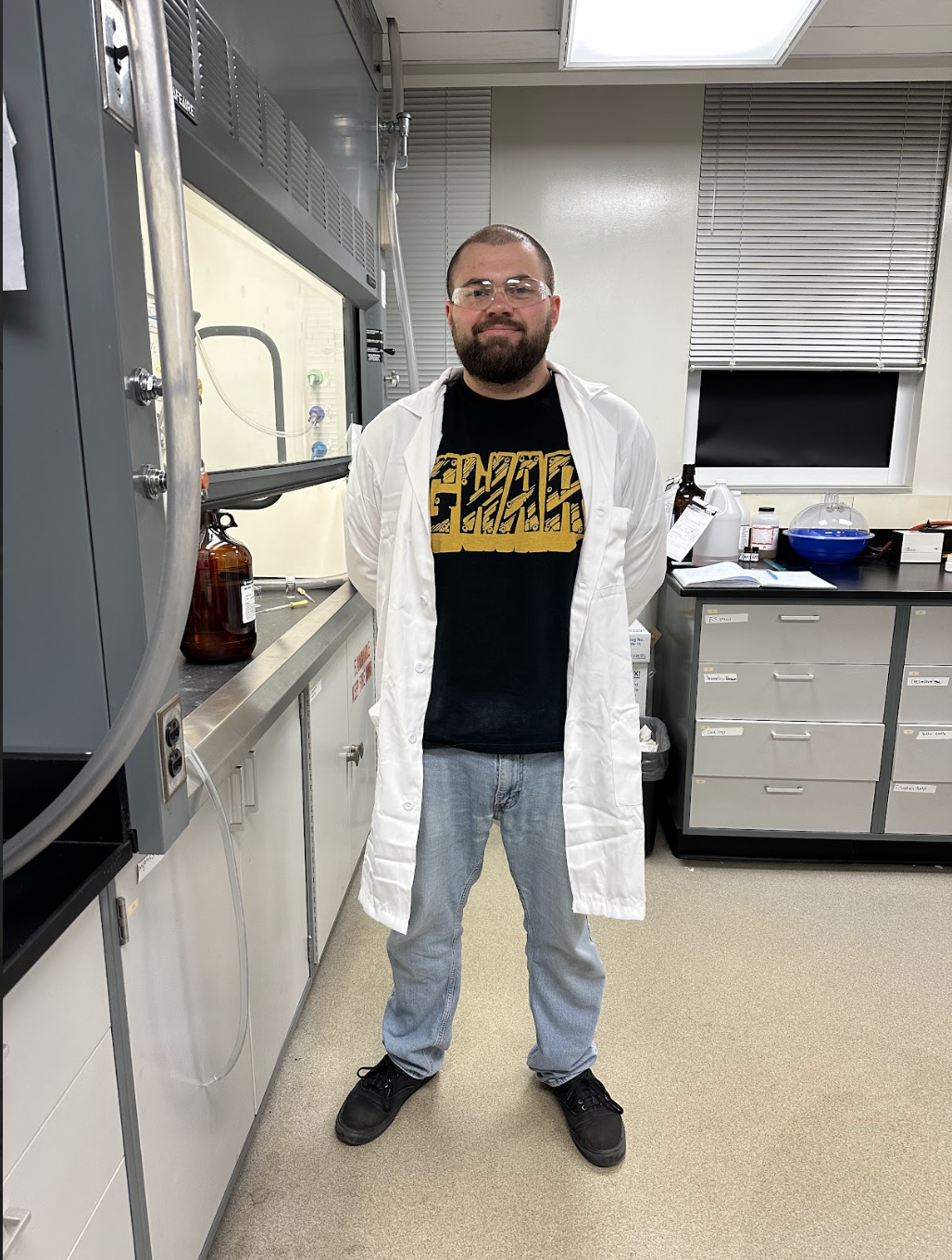
Over the last decade there has been significant interest garnered in water electrolysis, the process of splitting water into its constituent elements (hydrogen gas and oxygen gas). Hydrogen gas holds the greatest potential as an alternative to petroleum, and catalysts are needed to drive hydrogen production via water electrolysis. Jake Gallahan, a fourth-year Chemistry major at West Chester University (WCU), is on the hunt to find the best one.
Electrocatalysts, substances that facilitate the conversion of chemical to electrical energy, are essential for performing water electrolysis. Currently, scientists are primarily using platinum to drive these reactions. However, due to its high cost, it would be difficult to cheaply produce hydrogen gas in abundance according to Dr. Danielle Chirdon, Assistant Professor of Chemistry and research advisor. Dr. Chirdon and Gallahan are instead pursuing molybdenum as an alternative catalyst, exploring the way its reactivity is changed by attaching other chemical groups to it.
Gallahan began working with Dr. Chirdon on this project in the summer of 2025, assisting her in synthesizing and characterizing the initial molybdenum complex, as well as any subsequent derivatives. In addition to these duties, he also worked to optimize procedures, specifically to ensure adequate product purity was achieved, which Dr. Chirdon expressed was a primary hurdle.
The position was advertised across the chemistry department and funded by the Jean Dreyfus Lectureship Grant, a grant that funds summer research fellowships for undergraduate students. According to Gallahan, he has always been interested in working with metals due to their unique properties and reactivity. His interest only grew during an Inorganic Chemistry class series at WCU. Dr. Chirdon became passionate about alternative fuel sources when working for the Department of Energy during her undergraduate studies, where she learned about the harmful byproducts of and ineffective disposal of petroleum. This is an important study, because cleaner fuels limit pollution from power plants and vehicles. Additionally, they can be produced in the United States, which lowers costs and limits reliance on foreign providers.
In the future, Gallahan and Dr. Chirdon plan to continue the project with hopes to eventually pair the catalyst with a light-absorbing dye, thereby using the absorbed light to power the catalyst. After graduation, Gallahan would be open to a synthetic or process role in any industry, but stated he is specifically interested in pharmaceuticals or consumer science. He also plans to pursue graduate school after gaining a few years of meaningful industry experience.
Gabrielle Joyce is a fourth-year Chemistry major. GJ1046322@wcupa.edu
Very direct writing!! Very proud of you gabby!!