

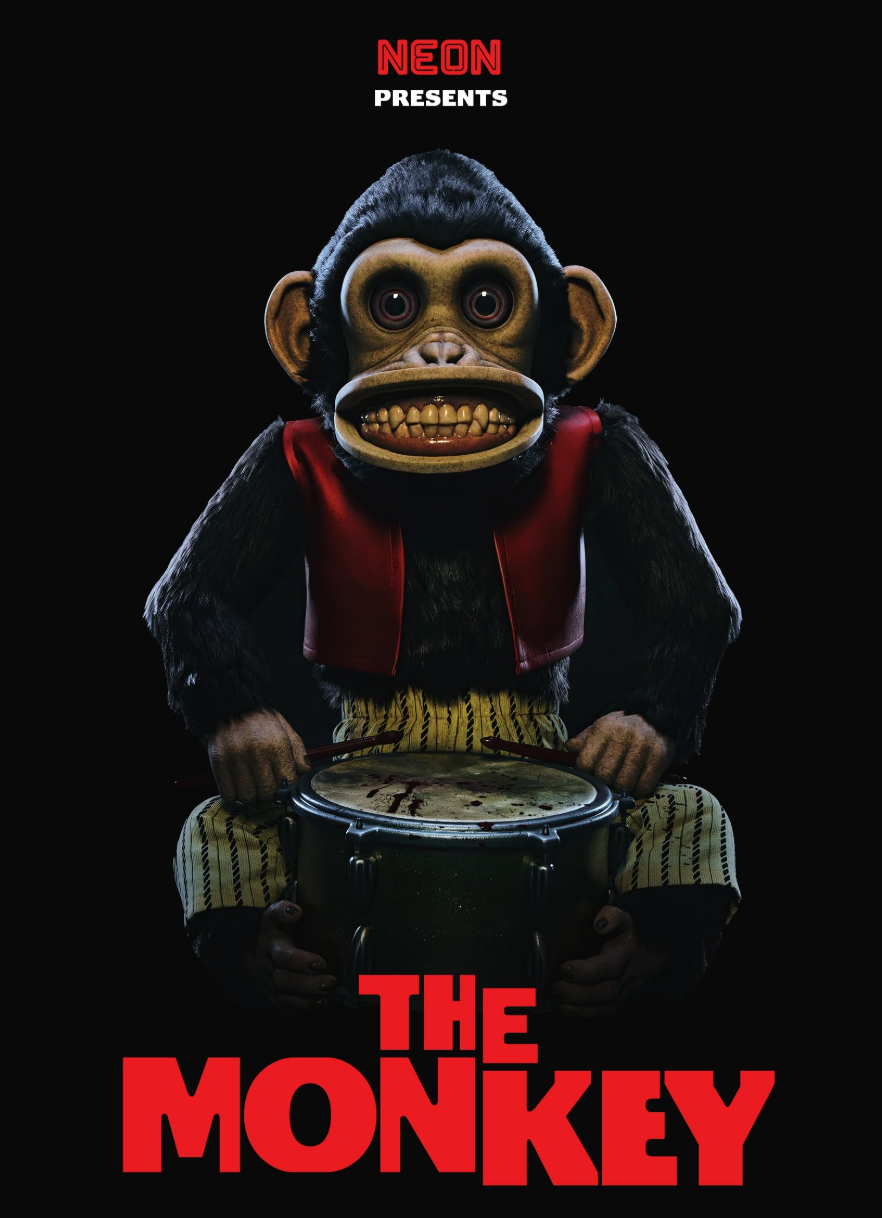
Image: “The Monkey” Movie Poster via IMDb
The last thing one expected Osgood Perkins to follow up “Longlegs” (2024) with — a film rewarded both critically and commercially for its dark originality — is a comedic adaptation of a Stephen King short story. Despite this, on Feb. 21 his new feature “The Monkey” was released nationwide to an impressive box office response and a tepid yet respectable critical approval. Starring Theo James, the film follows a pair of twin brothers, haunted by a past filled with death, on their quest to recover the toy monkey they deem responsible for a family curse. On paper, the film has all the makings of a success, and its reception upon release backs that up. A vaguely 80’s aesthetic (despite the film taking place no earlier than 1999) to cash in on nostalgia? Check. A tongue-in-cheek sarcastic tone that demonstrates how cool and self-aware the movie is? Check. Buckets upon buckets of blood to satisfy the gore-lust of today’s horror fans? Check. The fact that “The Monkey” checks every box is the biggest part of its problem, a problem Perkins’ last feature suffered gravely from in my opinion: a total lack of individual voice.
“The Monkey” follows a pair of twins on a quest to destroy the toy monkey they deem responsible for the years and years of freak accidents that have plagued their family tree. While it improves on the problems of “Longlegs” (the self-serious attitude towards ridiculously cheap satanic panic imagery, the parade of boring symmetrical medium-shots designed to be included in Instagram slideshows and TikTok edits next to whatever Wes Anderson film floats your boat) its improvements open a new can of issues. It takes a comedic tone towards death from its opening scene to its closing scene, even its tagline reads “Everyone dies. And that’s fucked up.” On paper that’s a smart way to externalize the trauma your main characters hold around death, but from an audience perspective it just removes all emotional weight from the film. A lot of people die in this movie, and sharing what I’ll refer to as “the big one” to avoid spoilers, all of those deaths are comedic. But comedy desensitizes, and on the big screen death always holds some kind of emotional weight. Whether it’s a loss, a victory for the hero or even just unsettling, death always needs to matter on screen. But when you make your entire film adapt the world view of a character who is so used to death it’s shrug-worthy to him, what you get is a film where each death acts as a speed bump rather than something we need to care about as audience members. Death can’t be cheap if you want your audiences to care about your movie.
The greatest strength of “The Monkey” is its visuals, which I’m willing to admit are a welcome step up from the mundanity of “Longlegs.” Symmetry is treated as something impressive in cinema, but without a sense of contrast, it makes for a boring shot. Perkins seems to have abandoned symmetry in favor of complexly-angled shots and hallucinogenic dream sequences, which display much more personality behind the camera. It’s unfortunate that one of the most interesting moments of visual symbolism in the film was made limp when it wasn’t used as the final shot, instead opting to end the film with another meaningless death for laughs. Our moment of narrative catharsis, and a moment that threatened to elevate Perkins beyond just occasionally competent, had its impact stripped because he simply couldn’t help himself.
Therein lies my case against “The Monkey.” There were multiple awkward line readings that obviously needed to be redone but never got another take because Perkins didn’t bother, multiple awkward special effects that should’ve been improved before they made it to our screens, multiple lines of dialogue that clearly needed to be rewritten before they made it to the final cut. I hold no grudge against “amateur” qualities in films, being a college student interested in filmmaking I know that those in glass houses shouldn’t throw stones. But a lot of the flaws of “The Monkey” are the kinds of issues you’d expect to arise from a college student’s short film, not from someone as established as Perkins. There was a lack of polish that didn’t strike me as a symptom of indie filmmaking as much as a symptom of just not caring. When a film is a labor of love it’s palpable through the screen, with or without problems. I felt nothing here.
“The Monkey” will likely be beloved. It’s made to be beloved. It’s hard to not please a crowd with a horror-comedy, and it’s clear from the reception to “Longlegs” that audiences love Perkins and his work, warts and all. But at the end of the day, what do irony and sarcasm count for, especially in cinema? Where is their place in the long run? When you look back at what movies from 50, 80 or even 100 years ago have stood the test of time, how many of them were self-aware and wry? How many laughed at their own emotional beats? What legacy does making fun of sincerity have? Movie magic has withstood wars, technological advancements and even pandemics. Unfortunately for Perkins and “The Monkey,” I’m afraid irony has no place in movie magic.
Elijah Fischer is a third-year Media and Culture Major. AF997636@wcupa.edu